

So what now, José? The party's over, the lights are out, but the legacy of Carlos Drummond de Andrade remains eternal.
You’ve probably heard this line before. It sums up the genius of the greatest Brazilian poet of the 20th century. Drummond didn’t just write poems. He captured the Brazilian soul with irony, pain, and beauty.
He was born in Itabira, Minas Gerais. He took his “Minas Gerais spirit” to the world. He transformed everyday life into pure art. A stone in the path was never just a stone to him.
In this definitive guide, we’ll explore the life and work of this giant. You’ll learn about the different phases of his career, his essential books, and why he’s timeless.
Get ready for an unforgettable literary journey.
Who Was Carlos Drummond de Andrade?
Carlos Drummond de Andrade was born on October 31, 1902. The city of Itabira, the “city of iron,” left a lasting impression on his childhood. The son of farmers, he grew up in a rural and austere environment.
From an early age, he stood out as different. He was expelled from a boarding school for “mental insubordination.” That label was already a sign of his critical and questioning spirit.
He earned his degree in pharmacy in 1925. However, he never practiced the profession. His calling was literature, not medicine. He helped found “A Revista,” a landmark publication of Modernism in Minas.
He moved to Rio de Janeiro. There, he worked as a civil servant for decades. Bureaucracy never stifled his creativity. On the contrary, it fueled his observation of the world.
Drummond was a reserved man. Averse to fame, he declined membership in the Brazilian Academy of Letters. He preferred silence and writing.
Poet's Profile
| Given | Detail |
|---|---|
| Full Name | Carlos Drummond de Andrade |
| Birth | October 31, 1902 (Itabira, MG) |
| Death | August 17, 1987 (Rio de Janeiro, RJ) |
| Movement | Modernism (Second Generation) |
| Training | Pharmacy (UFMG) |
| Grand Prize | Jabuti (1968) |
| Debut Work | Some Poetry (1930) |
Drummond's Four Literary Phases
Drummond's body of work is vast and complex. To make it easier to understand, scholars divide it into four distinct phases. Each phase reflects a particular moment in his life and in the world.
1. The “Gauche” Phase (The Self Greater Than the World)
This is the phase of irony and isolation. The poet feels out of place, a “gauche” in life. The term comes from his famous “Poem of Seven Faces.”.
In this phase, the tone is caustic. It challenges traditional values and poetry itself. Free verse prevails. There are no mandatory rhymes, only freedom of thought.
Major works:
This is where “No Meio do Caminho” comes in. The poem caused a scandal at the time. The repetition of the word “stone” irritated conservative critics. Today, it is an absolute classic.
2. The Social Phase (The Self Smaller Than the World)
The world is plunged into war. World War II and the Vargas dictatorship have a profound impact on the poet. He steps outside himself and turns his gaze to the suffering of others.
Drummond becomes empathetic. The world’s pain becomes his own. It is political poetry, yet it does not lose its lyricism. He seeks collective solutions to human tragedies.
Major works:
In *A Rosa do Povo*, he reaches the height of his artistic maturity. Poems such as “A Flor e a Náusea” demonstrate the hope born on the dirty asphalt.
If you are looking for phrases that touch the soul, read this passage. Drummond's empathy here is palpable and inspiring.
3. The Metaphysical Phase (The Non-Self)
The postwar period brought disillusionment. The social utopia had failed. Drummond turned his attention to profound existential questions. The meaning of life and death came to the forefront.
His language becomes more refined. He returns to classical forms, such as the sonnet. His poetry is philosophical, dense, and reflective. He engages in a dialogue with nothingness and emptiness.
Major works:
The book Of course Enigma It is a masterpiece. The title itself is an oxymoron (a contradiction). It illustrates the complexity of understanding human existence.
4. The Memoir Phase (The Return)
In his old age, the poet looks back. His childhood in Itabira comes flooding back. He revisits his family, his friends, and the landscape of Minas Gerais.
It is a time of longing and reconciliation. The past is not just a memory; it is a living presence. The figure of the father is central to many poems.
Major works:
He immortalizes Itabira. The city he left behind physically has never left his heart. “Itabira is just a photograph on the wall,” he said, but with a sense of pain.



Main Themes and Style
Carlos Drummond de Andrade He revolutionized writing. His style is unmistakable. He masterfully blended the colloquial with the scholarly.
Everyday Life
Drummond saw poetry in the ordinary. A rock, a streetcar, a shoulder. Everything became a source of inspiration for reflection. He took poetry off its pedestal and placed it on the sidewalk.
Irony
Drummond's sense of humor is subtle. It serves as a defense against excessive sentimentality. He laughs at himself so he doesn't have to cry all the time.
“Mineiridade”
In his work, being from Minas Gerais is a state of mind. The mistrust, the silence, the quiet observation. All of this is present in his verses, even when he speaks of the world.
“To be from Minas Gerais is to not say what you do or what you’re going to do; it’s to pretend you don’t know what you know; it’s to speak little and listen a lot.”
Why Read Drummond Today?
Drummond is timeless. His anxieties are our anxieties. Urban loneliness, fear of the future, the search for love. All of this remains relevant today.
Moreover, he teaches us how to look. To see the “flower that breaks through the asphalt.” To find beauty where no one else sees it. Reading Drummond is an exercise in humanity.
For those looking for messages that inspire deep reflection, his poems are a real treat. They make us think about our role in the world.
Checklist: How to Start Reading Drummond
Not sure where to start? Follow this simple guide so you don't get lost in this vast body of work.
- Beginner: Read Poetic Anthology. This is a selection made by the author himself.
- Intermediary: Read The World's Sentiment. It's short, powerful, and exciting.
- Advanced: Face it The People's Rose. The longest and most complex book.
- Philosophical: Immerse yourself in Clear Enigma. To read at a leisurely pace and with a dictionary.
- Nostalgic: Read Boitempo. Perfect for anyone who loves childhood memories.

Fun Facts That Few People Know
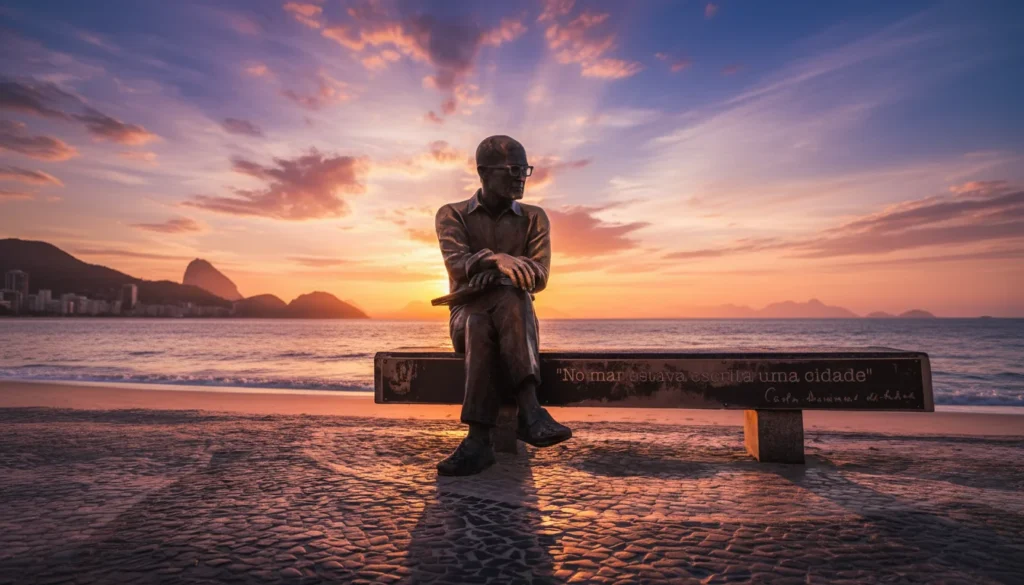
- The Statue: The famous statue on the Copacabana boardwalk is a constant target of vandalism. Its sunglasses are frequently stolen.
- Death of a Daughter: His only daughter, Maria Julieta, died 12 days before he did. They say he died of grief.
- Pen name: In 1922, he won a literary contest under the pen name “Joaquim do Telhado.”.
- The Beatles: Drummond translated Beatles lyrics into Portuguese. He loved the band's cheerfulness.
Expert's Verdict
Carlos Drummond de Andrade It's not just reading for school. It's reading for life. His ability to distill ideas is unmatched. He can say in two lines what a novelist takes 300 pages to convey.
If you want to understand Brazil and yourself, Drummond is a must-read. Start today. The stone in your path can be a stepping stone.
Note: ⭐⭐⭐⭐⭐ (5/5) – A must-have.
Reading Tips
Start with the short poems. “Quadrilha” and “José” are great places to begin. Don’t try to understand everything rationally. Just feel the rhythm and the imagery.
Frequently Asked Questions (FAQ)
1. What is Carlos Drummond de Andrade's most famous poem?
Probably “No Meio do Caminho” or “José.” Both are discussed at length and are representative of his style.
2. What does the “stone” mean in Drummond’s poem?
The stone symbolizes life's obstacles. These can be physical, existential, or emotional difficulties that we never forget.
3. Did Carlos Drummond de Andrade join the ABL?
No. He turned down several nominations to the Brazilian Academy of Letters. He preferred to maintain his independence and privacy.
4. What is Drummond’s “gauche” phase?
This is his first literary phase. It refers to the sense of social inadequacy and isolation typical of the poem “Seven Faces.”.
5. Where was Drummond born and where did he die?
He was born in Itabira, Minas Gerais, in 1902. He died in Rio de Janeiro in 1987 at the age of 84.