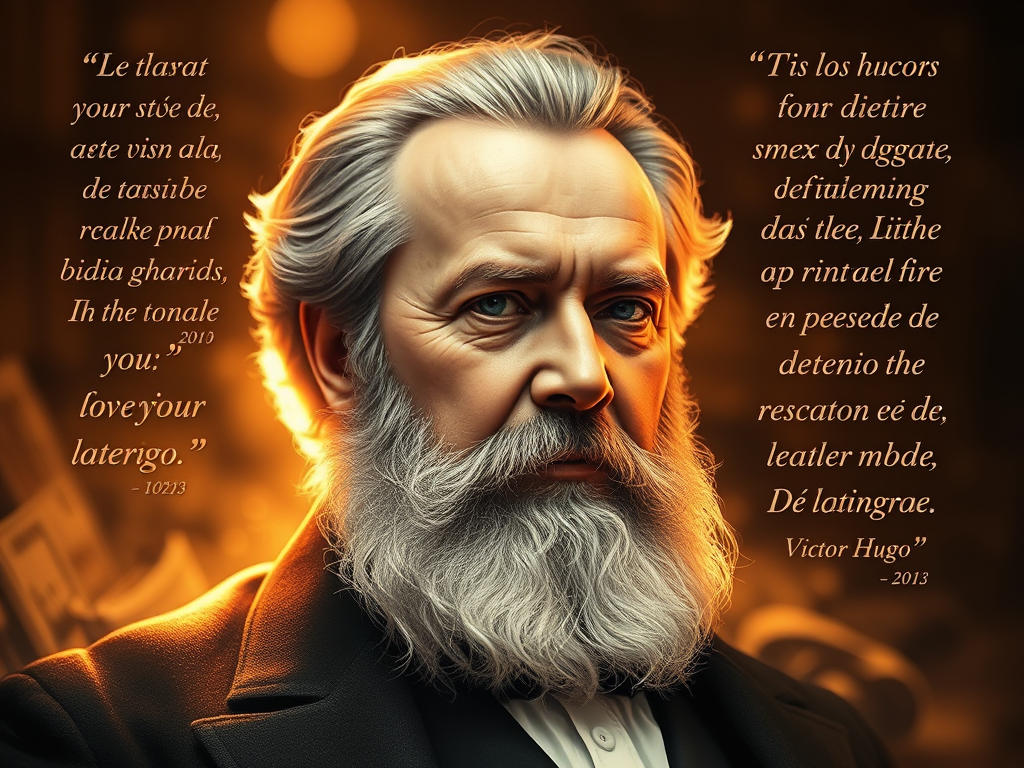
Inspirational Quotes by Victor HugoIn the vast universe of French literature, few names shine with the intensity and legacy of Victor Hugo.
Born in Besançon, France, February 26, 1802 and died in Paris, May 22, 1885, Victor Hugo transcended his era, the Romanticism, to become an icon of world literature.
This article, entitled Inspirational Quotes by Victor Hugo to Reflect on and Motivate Yourself, delve into the profound and multifaceted thinking of this brilliant author, exploring quotes that continue to inspire and motivate readers of all generations.
Get ready for a journey through words that echo the passion, justice, and beauty of the human condition, awakening your curiosity for the wisdom Victor Hugo's timeless classic.
Inspirational Quotes from Victor Hugo for Life
| Sentence | Source |
|---|---|
| “Darkness disappears in the presence of light, and selfishness in the presence of love.” | Les Misérables (1862) |
| “The future has many names: For the weak, it is the unattainable. For the fearful, it is the unknown. For the bold, it is opportunity.” | Unknown |
| “To have seen the face of happiness even once is enough to give us the measure of life.” | Les Misérables (1862) |
| “Freedom increases in proportion to the respect we inspire.” | Unknown |
| “To produce some ideas, to bring some words to life, such has been my ambition throughout my life.” | Speech at the French National Assembly, 1848 |
| “The wrinkles of the soul are sadder than those of the face.” | Les Misérables (1862) |
| “The book is cold, but loyal; silent, but eloquent; servant, but advisor; comforter, but demanding; present, but future.” | Unknown |
| “The first equality is equity.” | Unknown |
| “Love is like a tree: it bends on its own, roots deeply, and continues to flourish over a broken heart.” | Les Misérables (1862) |
| “Intelligence is the ability to adapt.” | Unknown |
| “When a woman speaks, silence should fall around her, as when one is about to hear an angel sing.” | Les Misérables (1862) |
| “There are no weeds or bad men. There are only bad farmers.” | Les Misérables (1862) |
| “A smile is the sun that drives winter from the human face.” | Les Misérables (1862) |
| “Progress is God's way of walking.” | Les Misérables (1862) |
| “The pen builds society; the sword only destroys it.” | Unknown |
| “What leads revolutions into the abyss is excess.” | Unknown |
| “Mercy toward the guilty is mercy toward yourselves.” | Les Misérables (1862) |
| “True greatness consists in making oneself small.” | Unknown |
| “There are men who are like paper, they absorb everything and have no color of their own.” | Les Misérables (1862) |
| “Prejudice is born of ignorance.” | Les Misérables (1862) |
| “Tolerance is the best of religions.” | Unknown |
| “The soul has illusions like the butterfly; reason has its own like the bee.” | Les Misérables (1862) |
| “Religions are like fireflies: they need darkness to shine.” | Les Misérables (1862) |
| “Memory is the perfume of the soul.” | Les Misérables (1862) |
| “Beauty is a letter of recommendation that nature gives us to make men love us.” | Notre Dame Cathedral (1831) |
| “Man has all rights because he has all duties.” | Unknown |
| “The dictionary is a universe in alphabetical order.” | Unknown |
| “A tear is the telescope of the soul.” | Les Misérables (1862) |
| “Laughter is the sun: it sweeps the winter from the human face.” | Unknown |
| “Love is the swift wing that God gave to the soul so that it may fly to heaven.” | Les Misérables (1862) |
| “Life is a flower, love is honey.” | Les Misérables (1862) |
| “A mother's heart is an abyss at the bottom of which forgiveness is always found.” | Unknown |
| “There is nothing like a dream to create the future. Utopia today, flesh and blood tomorrow.” | Unknown |
| “Jealousy is, in large part, a hunger for love.” | Les Misérables (1862) |
| “Ingratitude is independence of heart.” | Les Misérables (1862) |
| “Tyrants always fall into their own trap.” | Unknown |
| “Wisdom is the sun of the soul.” | Les Misérables (1862) |
| “Habit is a second nature that destroys the first.” | Notre Dame Cathedral (1831) |
| “Marriage is the twilight of love.” | Unknown |
| “Hatred is the anger of the weak.” | Unknown |
| “Faith consists of believing in what we cannot see, and the reward for this faith is seeing what we believe in.” | Unknown |
| “Piety is the echo of suffering.” | Unknown |
| “The eyes are the mirror of the soul.” | Unknown |
| “Consciousness is the presence of God in man.” | Les Misérables (1862) |
| “Duty is love; love is duty.” | Les Misérables (1862) |
| “True heroism lies in being a hero unto oneself.” | Unknown |
| “Music expresses that which cannot be said and on which it is impossible to remain silent.” | Unknown |
| “The beautiful is as useful as the useful; perhaps more so.” | Unknown |
| “Happiness is sometimes like a fairy-tale palace built on clouds.” | Les Misérables (1862) |
| “A book is a friend that never deceives us.” | Unknown |
| “Man is a god when he dreams and a beggar when he reflects.” | Unknown |
| “History is the resonance of the past in the future; the reflection of the future in the past.” | Unknown |
| “Patience is the virtue of the strong.” | Unknown |
| “Work is a blessing.” | Unknown |
| “Nature is an open book.” | Unknown |
| “The hope is the last to die.” | Popular proverb, Victor Hugo often used proverbs in his works. |
| “Adversity is a diamond.” | Unknown |
| “Time is the great teacher.” | Unknown |
| “Silence is sometimes the most eloquent response.” | Unknown |
| “Courage grows with the occasion.” | Unknown |
| “Forgiveness is the most beautiful revenge.” | Unknown |
| “Unity is strength.” | Popular proverb, Victor Hugo often used proverbs in his works. |
Conclusion:
Victor Hugo's words, full of wisdom and emotion, continue to resonate through the ages, offering us inspirational quotes that light our way.
This article is just a small glimpse into the vastness of his legacy. We invite you to continue exploring the richness of Victor Hugo's thinking and that of other inspiring authors at Messages that Inspire.
Discover more messages that uplift the soul and motivate you to live a fuller, more meaningful life.
To learn more about Victor Hugo, visit the page of the Wikipedia.

FAQ: Frequently Asked Questions
| Question | Answer |
|---|---|
| 1. Where and when was Victor Hugo born? | Victor Hugo was born in Besançon, France, on February 26, 1802. |
| 2. In which literary period did Victor Hugo stand out? | Victor Hugo was one of the leading authors of French Romanticism. |
| 3. What are Victor Hugo's most famous works? | Some of Victor Hugo's most famous works include Les Misérables, Notre Dame Cathedral, The Man Who Laughs, The Workers of the Sea e Ninety-Three, as well as several plays and poems. |
| 4. Was Victor Hugo just a writer? | No, Victor Hugo was also a poet, playwright, essayist, visual artist, statesman, and human rights activist. |
| 5. How important is Victor Hugo to French literature? | Victor Hugo is considered one of the greatest French writers of all time. His work has influenced generations of authors and continues to be widely read and studied around the world. |
| 6. What are the recurring themes in Victor Hugo's work? | Recurring themes in Victor Hugo's work include social justice, freedom, equality, fraternity, love, redemption, the fight against oppression, and the defense of human rights. |
| 7. Did Victor Hugo have any connection with politics? | Yes, Victor Hugo had an active political life. He was a deputy and senator, defending republican and progressive ideals. He went into exile during Napoleon III's regime for opposing the emperor. |
| 8. Where can I find more quotes and information about Victor Hugo? | In addition to this article and the link to Wikipedia provided, you can find more quotes and information about Victor Hugo in quotation books, literary websites, and online databases on French literature. |