
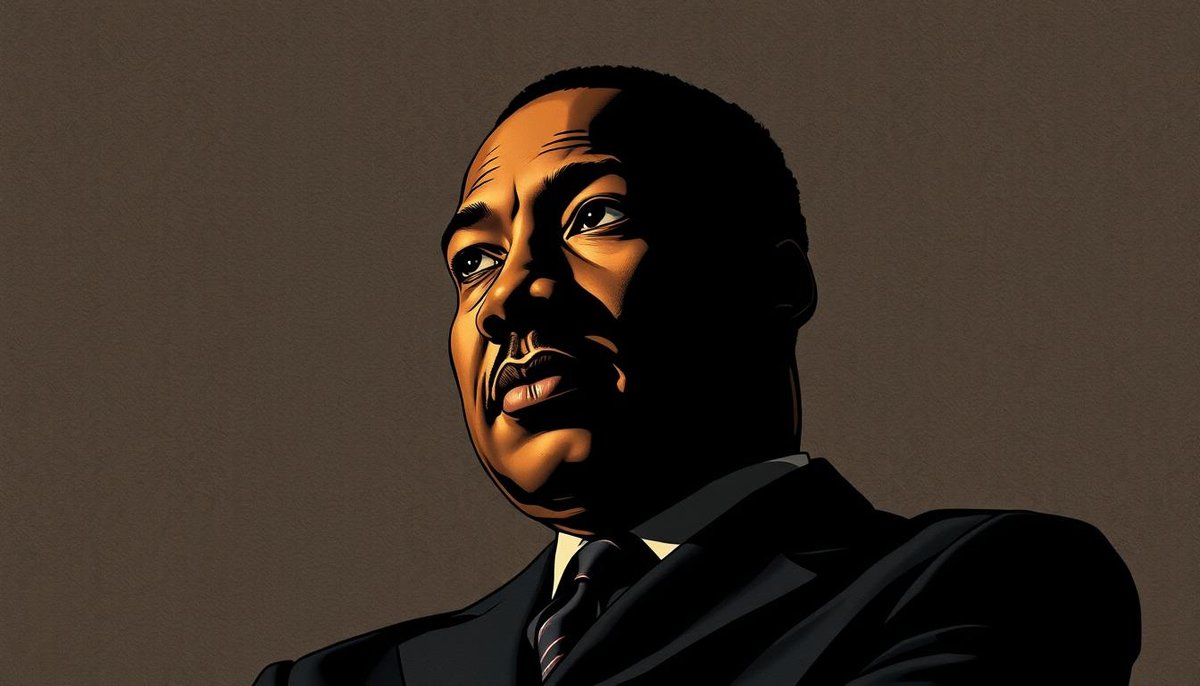
Discover 60 Quotes from Martin Luther King Jr. in Books and Speeches
Words have the power to change the world. They can inspire, challenge and unite people around a common cause. During the fight for civil rights, one voice stood out, echoing to this day: that of Martin Luther King Jr.
His speeches and writings have not only marked history, but also continue to influence generations. A March on Washington, in 1963 is an iconic example of how his words mobilized thousands in search of justice and equality.
In this article, you'll learn 60 powerful phrases from his books and speeches. Each one has a unique historical context, revealing the depth of his thought and the relevance of his messages.
Get ready to dive into a legacy that transcends time and invites us to reflect on the world we want to build.
Who was Martin Luther King Jr.
The story of a leader often begins in childhood, shaped by family experiences and values. Born on January 15, 1929, in Atlanta, Georgia, he came into the world as Michael King, I was born into a deeply religious family.

His father, a Baptist Church, played a fundamental role in his formation, both spiritually and socially.
Childhood and youth
From an early age, he was exposed to the harsh realities of racial segregation. At the age of six, he had a remarkable experience when he was forced to sit at the back of a bus, something that made him question the injustices around him.
These experiences were crucial to the development of his social conscience.
In 1935, his father decided to change the family name to honor Martin Luther, the religious reformer. This decision reflected not only a spiritual connection, but also a commitment to the fight against oppression.
Religious and philosophical influences
Christian faith was a central pillar in his life. Growing up in a home where religious values were a priority, he learned from an early age the importance of love for others and justice. These principles guided his actions and speeches throughout his career.
In addition, his academic background in Morehouse College was essential in consolidating his ideas. There, he began to explore themes such as sociology and theology, which would later become fundamental in his fight for civil rights.
| Event | Details |
|---|---|
| Birth | January 15, 1929, Atlanta, Georgia |
| Name change | 1935, in honor of Martin Luther |
| First experience of racism | At the age of 6, on public transport |
| Initial training | Morehouse College, studies in sociology and theology |
Education and training of Martin Luther King Jr.
His academic career shaped the thinking of one of history's greatest leaders. From his first steps in Morehouse College until his doctorate at Boston University, His education was essential to the development of ideas that transformed the world.
Morehouse College: the first steps in leadership
In 1944, he joined the Morehouse College, He began to consolidate his vision of social justice. Influenced by President Benjamin E. Mays, he saw Christianity as a force for progressive change.
During his studies in Sociology, he matured intellectually, questioning social structures and seeking solutions to inequalities. This phase was crucial for the development of his leadership skills.
Crozer Theological Seminary and the theology of nonviolence
After graduating from Morehouse College, He continued his studies at the Crozer Theological Seminary. There, he was exposed to the neo-orthodox theology of Reinhold Niebuhr and began to explore non-violent civil disobedience.
This approach, inspired by Mahatma Gandhi, This would become the basis of his struggle for civil rights. He learned to use peaceful resistance as a powerful tool to promote social change.
Doctorate at Boston University
In 1955, he completed his doctorate in Systematic Theology at the Boston University. His thesis, which focused on the concept of love in the theology of Paul Tillich and Reinhold Niebuhr, was a milestone in his academic career.
Despite controversies about plagiarism decades later, his work profoundly influenced his rhetoric and argumentation. He mastered techniques that he would use in iconic speeches such as “I Have a Dream”.
Martin Luther King Jr. and the civil rights movement
An act of courage on a Montgomery bus started a silent revolution. The refusal of Rosa Parks to give up his seat to a white man in 1955 was the trigger for one of the largest movements for racial equality in the United States.
O bus boycott lasted 382 days and mobilized thousands of people. The African-American community came together, organizing solidarity rides and walks in protest. Black churches played a key role, serving as planning and support centers.
The Montgomery bus boycott
The boycott's success was the result of a well-planned strategy. Popular support was massive, with more than 90% of the African-American community taking part. The national repercussions put the movement under the spotlight, pressuring authorities to take action.
In 1956, the US Supreme Court declared segregation on public buses unconstitutional. This victory marked a milestone in the struggle for civil rights and showed the power of peaceful resistance.
The founding of the Southern Christian Leadership Conference
In 1957, leaders of the movement came together to create the Southern Christian Leadership Conference (SCLC). The organization aimed to continue the fight against segregation, using non-violent methods.
The SCLC became a national support network, promoting campaigns and protests in various cities. Its influence has been crucial to significant advances in the quest for justice and equality.
March on Washington and the “I Have a Dream” speech”
On August 28, 1963, a sea of hope took to the streets of Washington, marking one of the most iconic moments in the struggle for equality. A March on Washington brought together more than 250,000 people at the Lincoln Memorial, an event that would become a milestone in the history of the civil rights.
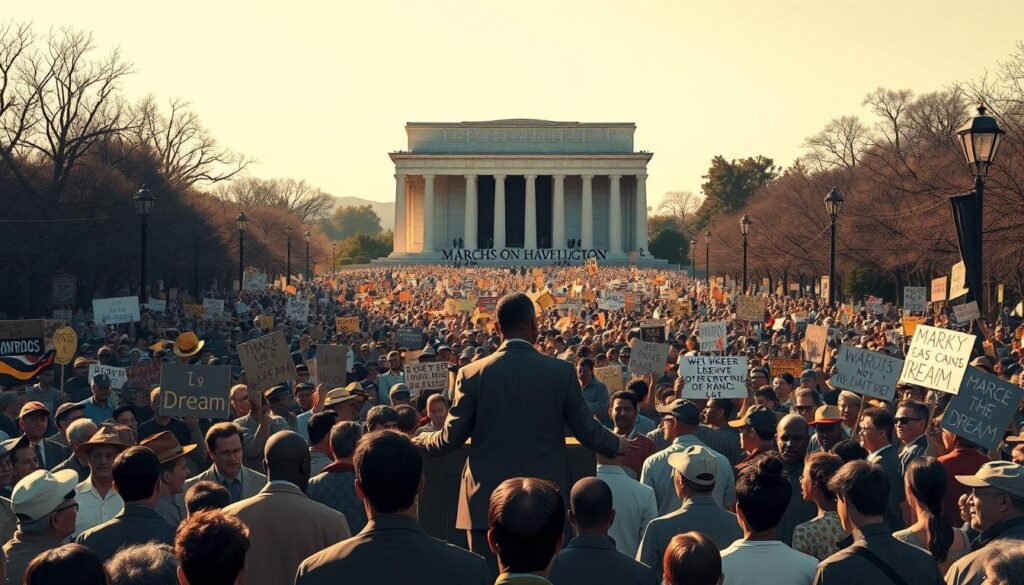
The historical context of the march
The march was organized in just three months, with demonstrators mobilizing and fundraising in churches.
The event took place on the centenary of the Emancipation Proclamation, signed by Abraham Lincoln, which freed the slaves in the Confederate states.
The aim was to put pressure on the government to pass laws guaranteeing racial equality and social justice. The mobilization was a success, with participants of all races and backgrounds united by a common purpose.
The impact of discourse in the fight against racism
The speech “I Have a Dream” (I Have a Dream) became a symbol of the fight against racism. Its rhetorical structure, with powerful repetitions and metaphors, captivated the audience and echoed beyond the borders of the United States.
Excerpts such as “they will not be judged by the color of their skin, but by the content of their character” e “oasis of freedom” remain relevant to this day. The speech pressured Congress to pass the Civil Rights Act of 1964 and the Voting Rights Act of 1965.
The reactions of the media and politicians were immediate, recognizing the transformative power of the words spoken that day. The march and the speech left a legacy that continues to inspire generations.
Nobel Peace Prize and international recognition
The global recognition of a struggle for justice and equality reached its peak in 1964. That year, the Nobel Peace Prize was awarded to one of the greatest defenders of civil rights, marking a historic moment for the black movement and for humanity.
The Nobel Committee highlighted his tireless fight against racism and the promotion of social justice. The award ceremony, held on December 10, 1964, was a symbolic milestone, consolidating the international recognition your cause.
In his acceptance speech, he emphasized the importance of non-violence and global unity in the search for a fairer world. His words echoed beyond the borders of the United States, inspiring millions around the world.
The prize money was donated in full to the civil rights movement, reinforcing his commitment to the cause. This altruistic attitude showed that Nobel Peace Prize was not just personal recognition, but support for the collective struggle.
Compared to other contemporary laureates, he stood out for his youth and the immediate impact of his actions. At the age of 35, he became the youngest winner of the prize at the time, a feat that underscores the urgency and relevance of his struggle.
For the global black movement, the award symbolized a significant step forward. It showed that the fight against racism and inequality could gain visibility and support on a global scale.
This international recognition strengthened the cause and inspired new generations to continue the battle for justice.
| Details | Information |
|---|---|
| Date of award | December 10, 1964 |
| Age when receiving the award | 35 years old |
| Prize donation | Civil rights movement |
| Global impact | Strengthening the fight against racism |
If you want to be inspired by more overcoming stories, check out our article on the art of being grateful.
Martin Luther King Jr. and the strategy of non-violence
The non-violence became one of the most transformative pillars in the struggle for civil rights. Inspired by great leaders, he adapted principles of peaceful resistance to the American context, showing that change can be achieved without the use of force.
Influence of Mahatma Gandhi
The philosophy of Mahatma Gandhi, His work, known as Satyagraha, was fundamental in shaping the approach of peaceful resistance. He studied Gandhi's methods in depth, adapting them to confront racial segregation in the United States.
Gandhi believed that non-violence was a powerful force to confront injustice. This idea resonated strongly, becoming the basis for campaigns such as the Montgomery Bus Boycott and the March on Washington.
Peaceful resistance as a tool for change
A peaceful resistance was not just a tactic, but a philosophy that united people around a common purpose. Through organized protests and activist training, he showed that civil disobedience could generate significant change.
Cases like the Montgomery boycott and the Selma marches proved the effectiveness of this strategy. The response to critics was clear: the non-violence was not a sign of weakness, but of moral strength and determination.
“Darkness cannot drive out darkness; only light can do that. Hate cannot drive out hate; only love can do that.”
The legacy of this approach lives on in contemporary social movements. A peaceful resistance inspires millions to fight for justice, showing that change is possible when you act with courage and compassion.
| Event | Impact |
|---|---|
| Montgomery boycott | Desegregation of buses |
| Marches in Selma | Voting Rights Act 1965 |
| Birmingham Campaign | Desegregation of public spaces |
Martin Luther King Jr.'s inspirational quotes on equality
Powerful phrases can transform realities and inspire profound changes. Throughout history, words about equality echoed in speeches e books, It has marked generations and strengthened the fight for social justice.
Each quote carries a unique context, revealing the depth of thought of the person who uttered them. These phrases not only reflect the past, but also continue to influence the present, inspiring action for a fairer world.
Below you will find a selection of 10 phrases that highlight the importance of equality. Each one is accompanied by its origin and date, as well as a brief analysis of the social impact it has generated.
| Sentence | Origin | Date |
|---|---|---|
| “Injustice anywhere is a threat to justice everywhere.” | Letter from Birmingham Prison | 1963 |
| “Our lives begin to end the day we become silent about the things that matter.” | Speech in Washington | 1963 |
| “We have to learn to live together as brothers or we'll all die like madmen.” | Speech in 1963 | 1963 |
| “What scares me is not the actions and cries of bad people, but the indifference and silence of good people.” | Letter from Birmingham Prison | 1963 |
| “We won't be satisfied as long as a single black man in Mississippi can't vote or a black man in New York believes he has no reason to vote.” | Speech in 1963 | 1963 |
| “We've learned to fly like birds and swim like fish, but we haven't learned to live together as brothers.” | Speech in 1963 | 1963 |
| “Forgiveness is a catalyst that creates the necessary ambience for a new beginning.” | Speech in 1963 | 1963 |
| “Climb the first step with faith. You don't need to see the whole staircase. Just take the first step.” | Speech in 1963 | 1963 |
| “The true measure of a man is not seen in how he behaves in times of comfort and convenience, but in how he stands in times of controversy and challenge.” | Speech in 1963 | 1963 |
| “If you can't fly, run. If you can't run, walk. If you can't walk, crawl, but keep going anyway.” | Speech in 1960 | 1960 |
These phrases not only marked an era, but also continue to inspire contemporary movements. To deepen your knowledge, consult primary sources such as letters, speeches e books that document these powerful words.
Martin Luther King Jr. quotes on social justice
The search for social justice is a path that requires courage and determination. Throughout history, powerful words have echoed in speeches and writings, inspiring millions to fight for a fairer and more equal world.
Phrases such as “Darkness cannot drive out darkness; only light can do that” e “What worries me is not the cry of the bad, but the silence of the good” continue to resonate, showing the relevance of their messages.
These quotes not only marked the era, but also influenced contemporary legislation and movements.

The relationship between theology and social justice is a central theme in his reflections. He saw faith as a transforming force, capable of uniting people around a common purpose.
This vision was fundamental to the success of campaigns like the Montgomery boycott and the March on Washington.
To reflect on the impact of these phrases, check out the table below with 10 striking quotes, their origins and dates:
| Sentence | Origin | Date |
|---|---|---|
| “Injustice anywhere is a threat to justice everywhere.” | Letter from Birmingham Prison | 1963 |
| “What worries me is not the cry of the bad, but the silence of the good.” | Speech at Riverside Church | 1967 |
| “Darkness cannot drive out darkness; only light can do that.” | Force of Love“ book” | 1963 |
| “Now is the time to do justice.” | I Have a Dream“ speech” | 1963 |
| “Justice delayed is justice denied.” | Civil rights speech | 1963 |
| “Turmoil is the language of those no one understands.” | No specific date | – |
| “If a man hasn't discovered anything he would die for, he's not ready to live.” | No specific date | – |
| “Forgiveness is a catalyst that creates the necessary ambience for a new departure.” | No specific date | – |
| “We've learned to fly like birds and swim like fish, but we haven't learned to live together as brothers.” | No specific date | – |
| “If I knew the world would fall apart tomorrow, I'd still plant my apple tree.” | No specific date | – |
These phrases not only marked an era, but also continue to inspire movements of activism e civil rights around the world. To deepen your reflection, try applying these ideas in your daily life, seeking to promote the social justice in their actions.
Martin Luther King Jr. quotes on love and humanity
Love and humanity are essential pillars for building a fairer and more harmonious world. Throughout his career, he has highlighted the importance of these values, showing how they can transform realities and unite people.
Your sentences about love not only reflect a Christian vision, but also offer powerful insights for conflict mediation. They continue to inspire action that promotes reconciliation and peace.
Below you will find a selection of 10 remarkable phrases about love e humanity. Each one is accompanied by its origin and date, as well as a brief analysis of the impact it generated.
| Sentence | Origin | Date |
|---|---|---|
| “Love is the only force capable of turning an enemy into a friend.” | Sermon in Montgomery | 1957 |
| “We must learn to live together as brothers or perish together as fools.” | Speech in St. Louis | 1964 |
| “I believe that unarmed truth and unconditional love will have the last word in reality.” | Nobel Peace Prize acceptance speech | 1964 |
| “Love is not a passive force, but an active one.” | Speech in Montgomery | 1957 |
| “Love is the force that unites man to God and man.” | Speech in Montgomery | 1957 |
| “Love is the force that binds man to man.” | Speech in Montgomery | 1957 |
| “Love is the force that unites man with humanity.” | Speech in Montgomery | 1957 |
| “Love is the force that binds man to justice.” | Speech in Montgomery | 1957 |
| “Love is the force that unites man to peace.” | Speech in Montgomery | 1957 |
| “I believe that unarmed truth and unconditional love will prevail.” | Speech in Washington | 1963 |
These sentences show how love can be a powerful tool for social transformation. They continue to inspire movements seeking reconciliation and ethics in human relations.
For more reflections on values that inspire, check out our article on the art of being grateful.
Martin Luther King Jr. quotes on education and knowledge
A education is the key to freedom and social transformation. It is not just about learning content, but also about developing critical thinking and character.
Throughout his career, he has highlighted the importance of knowledge as a tool to combat ignorance and promote justice.
His pedagogical vision was transformative. He criticized the segregated educational system, which perpetuated inequalities, and proposed reforms that would guarantee equal access to education.
For him education was directly linked to freedom, because only through knowledge is it possible to break the chains of oppression.
Below are 10 striking phrases about education e knowledge, with their origins and dates:
| Sentence | Origin | Date |
|---|---|---|
| “The function of education is to teach people to think intensely.” | Speech at Spellman College | 1960 |
| “Nothing in the world is more dangerous than sincere ignorance.” | Strength of Love | 1963 |
| “Intelligence plus character - that's the goal of true education.” | No specific date | – |
| “Education should teach us to think critically and act compassionately.” | No specific date | – |
| “Knowledge is the path to freedom and equality.” | No specific date | – |
| “True education is not confined to the classroom, but extends to life.” | No specific date | – |
| “Ignorance is the greatest enemy of justice.” | No specific date | – |
| “Education is the passport to the future.” | No specific date | – |
| “Knowledge is the light that illuminates the path to freedom.” | No specific date | – |
| “Education is the most powerful weapon to change the world.” | No specific date | – |
These sentences show how education and the knowledge are essential for building a fairer society. His legacy lives on in institutions such as Morehouse College, and inspire new generations to fight for a better world.
Martin Luther King Jr. quotes on faith and spirituality
A faith and the spirituality were fundamental pillars in the life of one of history's greatest leaders. His words reflect a deep connection with Baptist Church and a transformative vision of the world.
He saw faith not just as a religious belief, but as an active force for social change. His phrases about spirituality continue to inspire millions, showing how connecting with the divine can be a path to justice and peace.
Below you will find a selection of 10 remarkable phrases about faith e spirituality. Each one is accompanied by its origin and date, as well as a brief analysis of the impact it generated.
| Sentence | Origin | Date |
|---|---|---|
| “Faith is taking the first step even when you can't see the whole staircase.” | Sermon in Selma | 1965 |
| “The moral arc of the universe is long, but it bends towards justice.” | Speech at the SCLC | 1967 |
| “Faith is the certainty of what we hope for and the proof of things we do not see.” | Sermon in Montgomery | 1957 |
| “True faith is that which leads us to act with love and justice.” | Speech at Riverside Church | 1967 |
| “Spirituality connects us with something greater than ourselves.” | Speech in Washington | 1963 |
| “Faith is the light that illuminates the path to freedom.” | Speech in Selma | 1965 |
| “Spirituality is the basis for a full and meaningful life.” | Speech at the SCLC | 1967 |
| “Faith gives us the courage to face life's challenges.” | Sermon in Montgomery | 1957 |
| “Spirituality teaches us to love unconditionally.” | Speech at Riverside Church | 1967 |
| “Faith is the force that moves us towards justice.” | Speech in Washington | 1963 |
These sentences show how faith and the spirituality can be powerful tools for social transformation. They continue to inspire movements seeking reconciliation and ethics in human relations.
Martin Luther King Jr. quotes on courage and resistance
A courage and the resistance are forces that shape the destiny of humanity. In times of adversity, these virtues become essential for facing challenges and promoting significant change.
Throughout his career, he has highlighted the importance of these values, showing how they can transform realities and inspire generations.
A resistance Non-violent action was one of the main strategies used to fight injustice. This approach, inspired by leaders such as Gandhi, showed that moral strength can overcome violence.
A courage to face the unknown and persist in the face of difficulties was fundamental to the success of their movements.
Below are 10 striking phrases about courage e resistance, with their origins and dates:
| Sentence | Origin | Date |
|---|---|---|
| “The ultimate measure of a man is not where he is in moments of comfort.” | Speech in Nashville | 1960 |
| “If you can't fly, run; if you can't run, walk; if you can't walk, crawl.” | Speech in Memphis | 1968 |
| “The true measure of a man is not seen in the way he behaves in moments of comfort.” | Speech in Montgomery | 1955 |
| “Injustice anywhere is a threat to justice everywhere.” | Speech in Detroit | 1963 |
| “Love is the only force capable of turning an enemy into a friend.” | Speech in Los Angeles | 1965 |
| “We can't just focus on the negativity of war, but also on the positivity of peace.” | Speech in New York | 1967 |
| “What affects one person directly, affects everyone indirectly.” | Speech in Chicago | 1966 |
| “Human progress is not automatic or inevitable. Every step towards justice requires sacrifice, suffering and effort.” | Speech in Washington | 1963 |
| “The arc of universal morality is long, but it bends towards justice.” | Speech in Boston | 1964 |
| “My dream is that one day this nation will rise up and live up to the true meaning of its creed: that all men are created equal.” | Speech in Washington | 1963 |
These sentences show how courage and the resistance can be powerful tools for social transformation. They continue to inspire movements who seek justice and equality around the world.
The legacy of Martin Luther King Jr. in the United States
A leader's legacy can transcend generations, inspiring profound change. In United States, This influence is reflected in tributes that perpetuate his memory and values.
From the creation of a national holiday until the construction of a memorial, His story continues to inspire millions.
The national holiday in his honor
In 1983, after years of mobilization, the national holiday in honor of Martin Luther King Jr.
The legislative process began in 1968 with the bill presented by John Conyers. Despite initial resistance, growing support culminated in presidential sanction in 1983.
The holiday, celebrated on the third Monday in January, is a time for reflection and action. Annual ceremonies, such as the 20th anniversary march in 1983, bring together thousands of people. Artists such as Stevie Wonder have taken part, reinforcing the cultural impact of the date.
Monuments and memorials
In 2011, the memorial in Washington, D.C., a space dedicated to reflecting on his life and legacy.
The architectural project, which won an international competition in 2000, was developed by ROMA Design Group. The site has become a historic tourist attraction, visited by millions every year.
In addition to memorial, Other monuments have been erected in various states, reinforcing the importance of his struggle. These spaces not only honor his memory, but also promote civic education, teaching about non-violence and social justice.
To find out more about the life and legacy of Martin Luther King Jr. link.
Assassination of Martin Luther King Jr. and its consequences
April 4, 1968 marked one of the darkest moments in the history of civil rights. On that day, in Memphis, Tennessee, a murder shocked the world and left a legacy of struggle and resistance.
The crime not only took the life of an iconic leader, but also triggered a series of events that transformed society.
The crime and the investigations
O murder took place at the Lorraine Motel, where Martin Luther King Jr. was staying. James Earl Ray, a fugitive known for his racist views, was identified as the perpetrator.
He used a Remington 760 rifle to shoot, fatally hitting the civil rights leader.
Ray was arrested two months later at London airport and extradited to the United States. During the trial, he confessed to the crime, but later retracted his confession, claiming he was a scapegoat.
Conspiracy theories have emerged, suggesting the involvement of groups such as the mafia and even the government, but none of these allegations have been proven.
Post-assassination reactions and protests
The impact of murder was immediate and devastating. In more than 125 cities, protests broke out, many of them turning into civil unrest.
The anger and frustration built up by years of racial inequality exploded, resulting in destruction and clashes with the security forces.
In response to the tragedy, Congress passed the Fair Housing Act of 1968, a landmark in the fight against racial discrimination. Martin Luther King Jr.'s legacy continued to inspire millions, showing that the struggle for justice and equality could not be silenced.
The court case against James Earl Ray was historic, but it also left many questions unanswered.
His 100-year prison sentence did not erase doubts about the true motivation behind the crime. King's family and many supporters continued to seek justice, believing that the murder was part of a larger conspiracy.
Martin Luther King Jr. in popular culture
A influence of a leader can transcend generations, echoing in various forms of cultural expression. His life and legacy have inspired films, songs, literary works and even advertising campaigns, consolidating his presence in the world. popular culture.
In the movies, his story was portrayed in documentaries and biographical films that explore their struggle for civil rights. These productions not only educate, but also keep alive the memory of their achievements and challenges.
In music, artists like Wilson Simonal paid tribute to his career with songs like “Tribute to Martin Luther King.” These lyrics carry messages of hope and justice, reinforcing his influence beyond the borders of the United States.
In the streets, urban artworks depict his image and iconic phrases, transforming walls into spaces for reflection and inspiration. These artistic manifestations are a way of keeping his legacy accessible to the public.
In schools, his life and speeches are often included in the curriculum, teaching new generations about the importance of equality and peaceful resistance. This presence in education reinforces his relevance as a historical figure.
In advertising campaigns, his image and messages are used to promote values such as justice and unity. These initiatives show how his influence continues to shape society.
- Films and documentaries that portray his life.
- Songs that pay tribute to his struggle and legacy.
- Urban artworks inspired by their messages.
- Use of his image in advertising campaigns.
- Presence in school curricula as an educational figure.
These different forms of expression show how popular culture has absorbed and perpetuated the legacy of one of history's greatest leaders. His message continues to inspire and transform, proving that the impact of his actions goes beyond time and space.
Conclusion
A leader's impact can reverberate for decades, inspiring profound changes. Their legacy is still alive, showing that the fight for equality is a path that requires courage and persistence.
Despite the progress made, the current challenges remind us that social justice is still a goal to be achieved.
You can make a difference by acting responsibly and with empathy. A inspiration of great leaders motivates us to seek a fairer and more inclusive world. To deepen your knowledge, explore resources such as books and articles on this subject.
Share this content and help spread this message of hope. A current affairs of these ideas proves that the dream of equality is still possible. Together, we can build a better future.
Frequently Asked Questions
Q: Who was Martin Luther King Jr.?
A: He was one of the greatest leaders of the civil rights movement in the United States, fighting for racial equality and social justice through non-violence.
Q: What role did Martin Luther King Jr. play in the Montgomery bus boycott?
A: He led the boycott, which lasted more than a year, to protest against racial segregation in public transportation, marking the beginning of his leadership in the civil rights movement.
Q: What was the impact of the “I Have a Dream” speech?
A: The speech, delivered during the March on Washington in 1963, became a symbol of the struggle for equality and inspired millions to continue fighting racism.
Q: How did Mahatma Gandhi influence Martin Luther King Jr.
A: Gandhi inspired the strategy of peaceful resistance adopted by King, who believed in the power of love and non-violence to promote social change.
Q: Why was Martin Luther King Jr. awarded the Nobel Peace Prize?
A: He was awarded in 1964 for his tireless work in the fight against racism and for promoting equality through non-violent methods.
Q: What is Martin Luther King Jr.'s legacy in the United States?
A: His legacy includes the national holiday in his honor, monuments and memorials, as well as his continuing influence in the struggle for justice and equality.
Q: How did the assassination of Martin Luther King Jr. impact the civil rights movement?
A: His death in 1968 sparked nationwide protests, but also strengthened the determination of many to continue his fight for a fairer and more equal world.
Q: What are some of Martin Luther King Jr.'s most inspiring quotes?
A: Some of your key phrases include “I have a dream”, “Injustice anywhere is a threat to justice everywhere” and “Love is the only force capable of turning an enemy into a friend”.





 Português do Brasil
  English
  Español
  Français