

In a world often marked by absurd and by the uncertainty, where the existence Human nature reveals itself in its fragility, giving rise to the ceaseless search for hope. Inspired by the philosophy of Albert Camus, I present “The Beacon of Hope“, an original story that explores the depths of the human soul, its conflicts, and its ability to find light even in the darkest of times.
Get ready for an engaging journey, where the mystery and suspense intertwine with a motivational and transformative message, inviting reflection and hope renewed.
Chapter 1: The Unknown Island
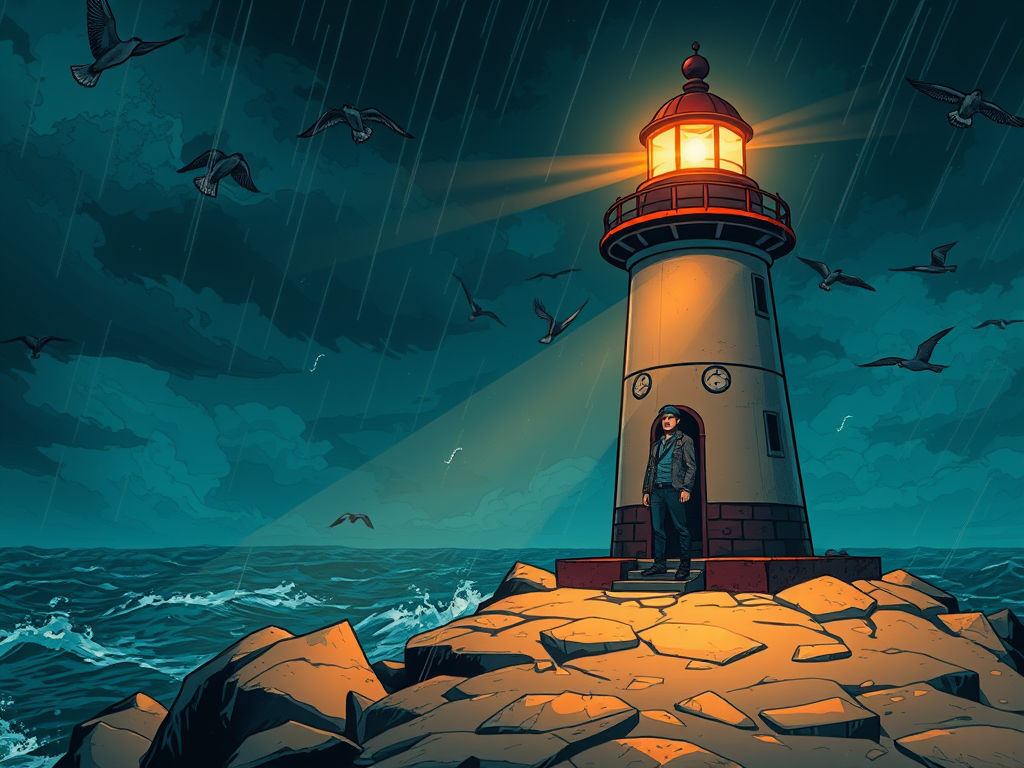
The wind howled like an ancient lament, lashing the rugged cliffs of the Unknown Island. In the center stood the Lighthouse of Hope, its solitary beam cutting through the darkness of the night.
Elias, the lighthouse keeper, was a man of few words and many silences. His eyes, marked by time and solitude, reflected the vastness of the ocean and the depth of a soul weathered by life.
Elias lived in tune with the tides and the seasons. His routine was a monotonous cycle of lighthouse maintenance, weather readings, and solitary meals.
His only company was the constant sound of the sea and the distant cries of the seagulls. That isolation, once imposed by duty, had become a choice—a refuge from a world he no longer understood.
That night, a particularly violent storm was battering the island. The waves crashed furiously against the shore, and the wind shook the lighthouse like a dry leaf.
Elias, sitting at the rustic wooden table, took a sip of bitter coffee as he watched the frenzied dance of the waves through the window.
He felt distant, detached from nature’s fury, as if the storm had been raging inside him for a long time.
Suddenly, a crash louder than the others echoed across the island. The lighthouse shook, and the light flickered briefly. Elias jumped, his heart racing.
Something had happened. Putting on his raincoat and grabbing his flashlight, he went out to face the storm.
Chapter 2: The Mysterious Castaway
The rain lashed his face as Elias battled the wind to reach the base of the lighthouse. The light from his flashlight could barely penetrate the curtain of water and darkness.
That was when he saw it. On the sand of the small cove, something dark and shapeless lay near the water’s edge.
Approaching cautiously, Elias recognized the figure of a man. He was unconscious, soaked, and injured. The storm had thrown him against the rocks.
Without hesitation, Elias carried the castaway into the lighthouse and laid him on his bed.
The man was young, with delicate features and a serene expression, even while unconscious. He was wearing tattered clothes and carried no documents or objects that could identify him. Who was he? Where had he come from? And how had he survived that storm?
Elias tended to the stranger's wounds, heated water for some tea, and waited. Hours passed, and the storm began to subside. Finally, at dawn, the castaway opened his eyes.



Chapter 3: Words in the Darkness
The stranger's eyes were a deep, mysterious blue, like the ocean on a calm day. He looked around, confused, and then at Elias, with a faint smile on his pale lips.
“Where… where am I?” he asked in a weak voice.
“At the Lighthouse of Hope,” Elias replied in his deep, hoarse voice. “You were found on the beach after the storm.”
The stranger remained silent for a moment, as if trying to remember something. “Esperança…,” he murmured. “It’s a beautiful name.”
Elias offered him some hot tea and a little bread. The stranger ate and drank gratefully, but did not reveal his name or his story. He just looked at Elias with those piercing eyes, as if he could read his soul.
Over the next few days, the stranger stayed at the lighthouse, regaining his strength. Elias cared for him in silence, respecting his mystery.
Communication between them was minimal, but intense. The stranger seemed to exude a calm and a wisdom inexplicable.
One night, as he sat at the table with Elias, the stranger said, “You seem to be carrying a heavy burden inside you, lighthouse keeper.”
Elias looked up, surprised. “Maybe,” he replied evasively.
“We all carry burdens,” the stranger continued. “But the weight doesn’t have to weigh us down. We can learn to float.”
Chapter 4: The Secret of the Lighthouse
The stranger's words resonated with Elias. It was as if he had touched an old wound, a pain he had been trying to ignore for years.
Elias had always been a solitary man, but at some point, solitude had turned into isolation, and isolation into despair.
The stranger sensed the whirlwind of emotions within Elias. “What’s troubling you, lamplighter?” he asked kindly.
Elias hesitated, reluctant to open up. But there was something about that stranger—an inexplicable sense of trust—that encouraged him to speak.
So he began to tell his story. He spoke about the loss of his wife, years ago, who had been taken by a relentless illness.
He spoke of the feeling of emptiness that had consumed him ever since, of the futility he felt in his existence.
The stranger listened in silence, without judgment. When Elias finished, he said, “The pain of loss runs deep; I know.”.
”But life, even with pain, is still life. And within every life, there is a flame—no matter how small—that can be rekindled."
“But how?” asked Elias, in despair. “When darkness completely surrounds us, how can we find that flame?”
The stranger smiled mysteriously. “Sometimes, the light we’re looking for is closer than we think. Maybe it’s been shining all along, just waiting to be seen.”
He pointed to the lighthouse beam, spinning majestically outside. “Like this lighthouse, which guides us through the darkness. Hope is like that light, lighthouse keeper. Always there, even when we can’t see it.”

Chapter 5: The Lesson of the Sea
The stranger’s words planted a seed of doubt in Elias’s heart. Was it possible to rekindle hope? Was it possible to find a purpose, even in the midst of pain?
In the days that followed, the stranger began to help Elias with his duties at the lighthouse. They worked side by side, in silence, but with a growing sense of harmony.
Elias watched the stranger intently, trying to unravel the mystery surrounding him. Who was he, after all? An angel? A ghost? Or just a man like himself, lost and found by the storm?
One day, as they watched the churning sea from the lighthouse porch, the stranger said, “The sea is like life, lighthouse keeper. Sometimes calm, sometimes stormy.”.
”But always in motion, always changing. We can't control the waves, but we can learn to navigate them."
Elias understood the metaphor. Life was like the sea—unpredictable and challenging. But just as a boat learns to navigate the waves, human beings can learn to navigate the challenges of existence.
Hope was not the absence of storms, but the ability to find one's way, even in the midst of them.
Chapter 6: The Lighthouse of Hope
The day came when the stranger announced that he was leaving. Elias felt a pang in his heart. That man’s mysterious and inspiring presence had transformed his daily life and rekindled a dormant flame in his soul.
“Where are you going?” asked Elias, showing emotion for the first time.
The stranger smiled enigmatically. “Wherever the wind takes me,” he replied. “But I will carry with me the light of this lighthouse, and the hope it represents.”
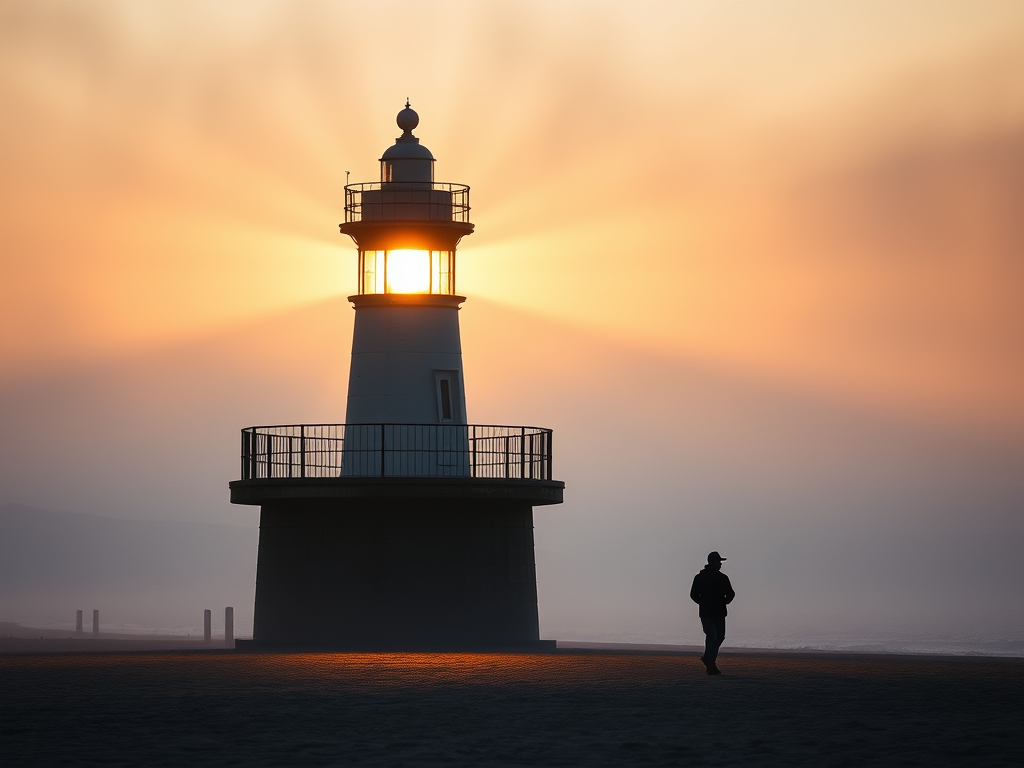
The next morning, the stranger left, walking along the beach toward the horizon. Elias watched him disappear into the morning mist, feeling strangely alone, yet at the same time, refreshed.
The loneliness of the lighthouse no longer seemed so oppressive. The light he kept burning now had a new meaning.
It was not only a guide for ships lost at sea, but also a beacon of hope for himself and for all those who, like him, were searching for meaning in the darkness.
Elias returned to his routine, but with a new perspective. Melancholy still lingered, but now it was tempered by hope.
He had learned that life, even with its losses and absurdities, could be lived with meaning and purpose.
And that, even in the darkest moments, the light of hope can always be found, shining like a lighthouse in the night.
Conclusion:
“The Lighthouse of Hope” invites us to reflect on the nature of existence, the inevitability of pain and the importance of hope as a driving force to overcome life's challenges.
Inspired by Camus's style, the narrative explores the depths of the human soul, revealing that even in the midst of absurdity and loneliness, it is possible to find light and meaning.
The final lesson is clear: the hope It is not an illusion, but a choice—a beacon that guides us through the darkness, lighting the way to a brighter future hopeful and full of existence significant.
Keep finding inspiration! Visit the Blog Messages that Inspire for more stories and reflections that will illuminate your journey.
Frequently Asked Questions:
| Question | Answer |
|---|---|
| What is the main message of the story? | Hope as a driving force for overcoming adversity and finding meaning in life. |
| What inspired this story? | The Works and Philosophical Style of Albert Camus. |
| Who is the main character? | Elias, the lighthouse keeper, who represents the search for meaning in the midst of loneliness. |
| Who is the mysterious character? | A castaway who embodies hope and wisdom. |
| What is the symbolism of the lighthouse? | It represents hope, a light in the darkness, and a guide amid uncertainty. |
| Is the setting of the story important? | Yes, the isolated island and the lighthouse reinforce the atmosphere of introspection and inner exploration. |
| Does the story have elements of mystery? | Yes, the castaway's identity and purpose create mystery and suspense. |
| What is the overall tone of the narrative? | Thought-provoking, melancholic, but with a final message of hope and positive change. |


