

Charles Dickens: 60 Inspirational Quotes from the Author
Já parou para pensar como as palavras podem tocar o coração e nos fazer refletir sobre a vida? Charles Dickens, um dos maiores nomes da literatura britânica, deixou um legado que vai além das páginas de seus livros.
His works, such as Oliver Twist e David Copperfield, are filled with phrases that remain relevant today, inspiring generations.
Born in 1812, Dickens used his writing to criticize the social injustices of his time, such as poverty and inequality. His stories, full of emotion and humanity, show that he was not just a storyteller, but a sensitive observer of the human condition.
In this article, you will find 60 inspiring quotes from the author, organized by theme and work. Each quote comes with its original context, allowing you to delve even deeper into Dickens' universe.
Get ready to be moved and inspired by the words of one of the greatest writers of all time.

Introduction: The Legacy of Charles Dickens
Literature has the power to connect us with stories that transcend time. Among the great names that have marked history, Charles John Huffam Dickens stands out as one of the most influential.
Born in 1812, he not only wrote memorable works, but also used his voice to criticize the injustices of his time.
Dickens had a challenging childhood, working in factories from an early age. These experiences shaped his critical and humanistic outlook, reflected in characters such as David Copperfield, who bear autobiographical traits.
His literary rise was marked by works that explore universal themes, such as social justice and the fight against inequality.
Who was Charles Dickens?
Charles John Huffam Dickens was more than just a writer. He worked as a journalist and editor, contributing to publications such as Household Words.
His trip to the United States in 1842 broadened his critical vision, influencing his later works. Dickens not only told stories, but also inspired social change.
Why do his words still resonate today?
Dickens' words remain relevant today because they address universal issues. His keen insight into human nature and his criticism of social injustices mean that his words still resonate today.
Furthermore, his ability to create complex and exciting characters connects directly with the reader.
Dickens left a legacy that goes beyond literature. His works influenced labor reforms and continue to inspire generations. If you haven't yet immersed yourself in his universe, it's time to discover why his words are so powerful.
The Life of Charles Dickens
A trajetória de vida de um dos maiores escritores britânicos é marcada por desafios e superações. Desde a infância até o auge de sua carreira, sua história é um testemunho de resiliência e paixão pela literatura.
Childhood and challenges
Nascido em uma família de classe média, ele enfrentou dificuldades financeiras desde cedo. Seu pai, John Dickens, He was imprisoned for debt in 1824, which forced the young writer to work in a grease factory at the age of 12.
Your mother, Elizabeth Dickens, tentou mantê-lo na escola, mas as circunstâncias eram adversas.
Essa experiência moldou sua visão crítica sobre as condições de trabalho e a desigualdade social, temas que mais tarde apareceriam em suas obras. “Poverty takes away not only comfort, but also dignity.”, he reflected in one of his writings.
Literary career and success
After overcoming the challenges of his childhood, he began his career as a journalist at Morning Chronicle. His pseudonym, Boz, gained popularity with the publication of Sketches made by Boz e The Adventures of Mr. Pickwick.
He married Catherine Hogarth in 1836, with whom he had ten children. His trip to the United States In 1842, he broadened his critical vision, influencing works such as Oliver Twist e David Copperfield.
Final years and death
In the last years of his life, he faced personal challenges, including his separation from Catherine in 1858 and his relationship with Ellen Ternan. Even with his health failing, he continued to write and tour giving public readings.
He died in 1870, victim of a stroke, leaving his last work unfinished., The Mystery of Edwin Drood. His legacy, however, lives on, inspiring generations with his unforgettable stories and characters.
Charles Dickens and the Victorian Era
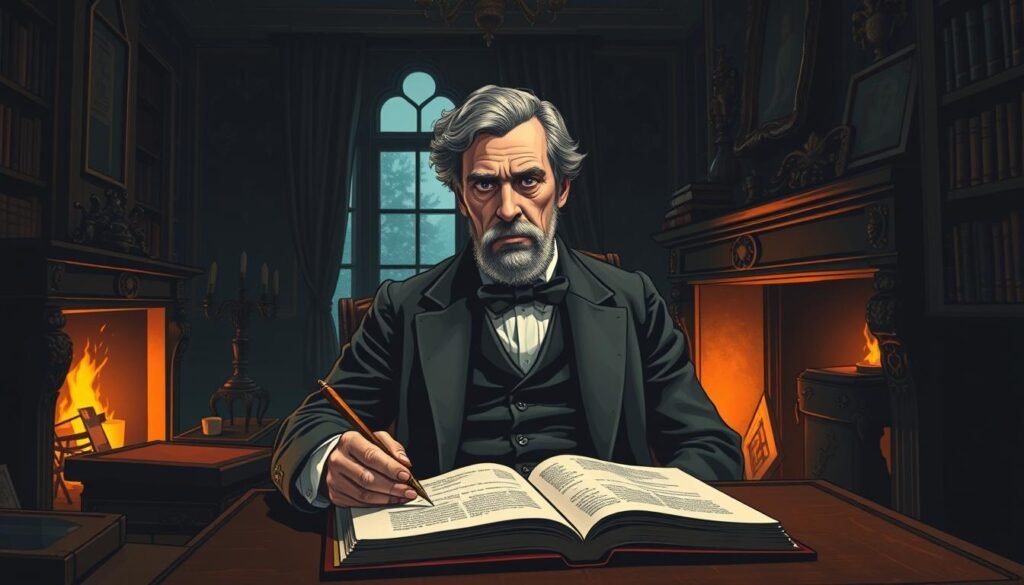
The Victorian era was a period of profound change, and Charles Dickens was one of the greatest observers of this scenario. Between industrial progress and social inequality, his works became a mirror of the contradictions of the time.
Influence on literature and society
Dickens not only wrote novels, but also influenced the society of his time. His texts, published in periodicals such as All Year Round, reached a wide audience and helped shape opinions on social issues.
He collaborated with other writers, such as Wilkie Collins, on plays that reinforced his criticisms. This partnership amplified his impact, showing how literature can be a tool for change.
Social criticism in his works
In works such as Nicholas Nickleby, Dickens denounced the corrupt educational system, exposing the injustices faced by children. In Hard Times, ele contrastou o otimismo social com o pessimismo diante da industrialização desenfreada.
“Inequality is the root of many evils, and literature should expose it.”
His novels, published in serial form, allowed readers to follow the stories over time, creating a deep connection with the characters and their struggles.
| Work | Main Theme | Social Impact |
|---|---|---|
| Nicholas Nickleby | Corruption in the education system | Public denunciation and changes in schools |
| Hard Times | Industrialization and inequality | Reflexão sobre os custos do progresso |
| Oliver Twist | Child poverty and exploitation | Awareness of children's rights |
The term “Dickensian” emerged to describe scenarios of social injustice, showing how his legacy remains relevant. His works not only entertain, but also invite reflection on the world we live in.
Major Works by Charles Dickens
Charles Dickens' works are a profound reflection of humanity's struggles and hopes. They not only tell stories, but also reveal truths about society and the human condition.
Among his most notable creations are Oliver Twist, David Copperfield e A Christmas Carol, each with its own impact and message.
Oliver Twist and the critique of poverty
Published in 1837, Oliver Twist It is one of the author's best-known works. Inspired by the Poor Laws of the time, the book tells the story of an orphan who faces neglect and exploitation in an orphanage. The main character becomes a symbol of the fight against social injustice.
Dickens uses the narrative to criticize the inhumane conditions faced by poor children. The phrase “Please, sir, I want more.” tornou-se emblemática, representando a coragem de Oliver diante da adversidade.
The work remains relevant, inspiring film and theater adaptations over the years.
David Copperfield: an autobiographical novel
Launched in 1849, David Copperfield é considerado um dos romances mais autobiográficos do autor. A história acompanha a jornada de um jovem que supera desafios como o trabalho infantil e a pobreza para se tornar um escritor de sucesso.
Many elements of the author's life are present in the work, such as resilience in the face of difficulties. The phrase “I am the author of my own life.” summarizes the essence of the narrative, which continues to inspire readers around the world.
A Christmas Carol and the Christmas spirit
Published in 1843, A Christmas Carol is one of the author's most beloved works. The story narrates the transformation of Ebenezer Scrooge, a miserly man who rediscovers the true meaning of Christmas after being visited by three spirits.
The work revitalized Christmas traditions, highlighting values such as generosity and compassion. The phrase “God bless us, every one!” tornou-se um símbolo do espírito de união e solidariedade. Até hoje, a história é adaptada em filmes, peças teatrais e até mesmo em quadrinhos.
Inspirational Quotes by Charles Dickens
Words have the power to transform lives and inspire change, and Charles Dickens' quotes are an example of this.
His quotes continue to resonate, touching on universal themes such as life, love, and justice. In this section, you will find 60 quotes that reflect the depth of his thinking.
Quotes about life and humanity
Dickens tinha uma visão única da condição humana, explorando temas como resiliência, esperança e superação. Suas frases sobre a vida continuam a inspirar pessoas ao redor do mundo.
| Sentence | Work | Year | Context |
|---|---|---|---|
| “No one is useless in this world who lightens the burden of another.” | Our Mutual Friend | 1864 | It reflects the importance of solidarity. |
| “It was the best of times, it was the worst of times.” | A Tale of Two Cities | 1859 | Duality between hope and despair. |
| “My advice is: never put off until tomorrow what you can do today.” | David Copperfield | 1850 | Emphasizes the importance of immediate action. |
Quotes about love and relationships
Love is a recurring theme in Dickens' works, portrayed in a profound and moving way. His quotes about relationships speak of passion, loss, and redemption.
| Sentence | Work | Year | Context |
|---|---|---|---|
| “A heart that truly loves never forgets.” | Great Expectations | 1861 | Explores the persistence of true love. |
| “O amor é a única força capaz de transformar o inimigo em amigo.” | Bleak House | 1853 | It highlights the transformative power of love. |
| “To love is to see the other as they truly are, and still accept them.” | Little Dorrit | 1857 | It addresses acceptance in love. |
Quotes about society and justice
Dickens was a fierce critic of the social injustices of his time. His quotes on society and justice remain relevant today, inspiring reflection on inequality and change.
| Sentence | Work | Year | Context |
|---|---|---|---|
| “Inequality is the root of many evils.” | Hard Times | 1854 | Criticism of unbridled industrialization. |
| “There is a tremendous power in sadness and despair.” | Bleak House | 1853 | It reflects resilience in the face of adversity. |
| “Justice must be blind, but not deaf.” | Nicholas Nickleby | 1839 | Emphasizes the importance of equity. |
Quotes from Oliver Twist
Oliver Twist, one of John Huffam's most iconic works, is a moving portrayal of the struggle between innocence and corruption.
The protagonist, an orphan who faces countless adversities, embodies purity in a world full of injustice. His journey is marked by phrases that continue to resonate, highlighting themes such as social inequality and human resilience.
Oliver Twist is more than a novel; it is a scathing critique of the inhumane conditions faced by the poor in the Victorian era.
The work influenced social reforms, drawing attention to child exploitation and the need for change. Below, you will find 10 notable quotes from the book, with their narrative contexts.
| Sentence | Chapter | Context |
|---|---|---|
| “Please, sir, I want some more.” | Chapter 2 | Oliver is punished for daring to ask for more food at the orphanage. |
| “The sun shines on both the good and the bad.” | Chapter 2 | It reflects Oliver's innocence in the face of the cruelty of the world. |
| “I’m very hungry and tired… I’ve walked a long way. I’ve been walking for seven days.” | Chapter 8 | Oliver describes his exhaustion after running away from the orphanage. |
| “Desolate, dark, and bitterly cold, it was a night for the well-housed and well-fed to gather around the glowing fire.” | Chapter 23 | Contrast between the lives of the privileged and the poor. |
| “Although Oliver was raised by philosophers, he was not theoretically familiar with the beautiful axiom that self-preservation is the first law of nature.” | Chapter 10 | It highlights Oliver's naivety amid evil. |
| “There is a passion for hunting something deeply implanted in the human heart.” | Chapter 10 | It reflects human nature and instincts. |
| “But death, fires, and theft make all men equal.” | Chapter 28 | It addresses equality in the face of tragedy. |
| “Tal é a influência que a condição de nossos próprios pensamentos exerce, mesmo sobre a aparência de objetos externos.” | Chapter 33 | Explores the subjectivity of human perception. |
| “Oh! The suspense: the fearful, acute suspense of standing idly by while the life of someone we love dearly hangs in the balance.” | Chapter 33 | Describes the anguish of waiting for an outcome. |
| “The sun—the bright sun, which brings back not only light but new life, hope, and freshness to man—burst upon the crowded city in clear, radiant glory.” | Chapter 46 | It symbolizes hope and renewal. |
Oliver Twist is a symbol of innocence in a corrupt world. His purity and resilience contrast with the wickedness of the adults around him.
John Huffam's work not only entertained, but also inspired social change, influencing labor reforms and the protection of children's rights.
Through his striking phrases, Oliver Twist invites us to reflect on justice, compassion, and the struggle for human dignity.
His message remains relevant, showing how literature can be a powerful tool for social transformation.
Quotes from David Copperfield
David Copperfield é uma obra que reflete a jornada de autodescoberta e superação. Publicado em 1849, o romance é considerado um dos mais autobiográficos de Charles Dickens.
The story follows David's life, from his difficult childhood to his transformation into a successful writer.
The work is full of phrases that continue to inspire, addressing themes such as love, resilience, and justice. Below, you will find 10 memorable phrases, organized in a table for easy reading and understanding.
| Sentence | Chapter | Context |
|---|---|---|
| “If there were no bad people, there would be no good lawyers.” | Chapter 39 | It reflects the duality between good and evil. |
| “Love is the most important thing in life.” | Chapter 42 | It highlights the transformative power of love. |
| “Procrastinação é o ladrão do tempo, agarre-o.” | Chapter 15 | Emphasizes the importance of acting immediately. |
| “Never be petty, never be fake, never be cruel.” | Chapter 52 | Betsey Trotwood's advice to David. |
| “Trivialities make up the sum of life.” | Chapter 28 | It reflects the importance of small details. |
| “I am the author of my own life.” | Chapter 1 | David takes control of his destiny. |
| “Renda anual de vinte libras, despesas anuais de dezenove libras e seis pence, resultado: felicidade.” | Chapter 12 | Addresses the importance of financial balance. |
| “We must face adversity courageously.” | Chapter 48 | A message of resilience and courage. |
| “Whatever the outcome, whether I will be the hero of my own life or someone else will take that place, these pages will reveal.” | Chapter 1 | Introdução à jornada de autoconhecimento. |
| “What I mean is that whatever I have attempted in life, I have attempted with all my heart.” | Chapter 63 | It reflects David's dedication and passion. |
A jornada de David Copperfield é marcada por desafios e superações. Desde o trabalho infantil até a busca por sua identidade, ele personifica a resiliência e o crescimento pessoal.
Many elements of the life of Charles Dickens are present in the work, such as his experience in a grease factory, which influenced the narrative.
Through his phrases, David Copperfield invites us to reflect on our own lives. The work remains relevant, showing how literature can be a powerful tool for inspiring and transforming.
Quotes from A Christmas Carol
Christmas is a time for reflection and renewal, and A Christmas Carol captures this essence in a unique way. Published in 1843, the work of Charles Dickens It is a tale that transcends time, addressing themes such as redemption, generosity, and the transformation of human beings.
The story of Ebenezer Scrooge, a miserly man who rediscovers the true meaning of Christmas after being visited by three spirits, continues to inspire generations. His journey of transformation is a powerful reminder that it is never too late to change.
Below, you will find 10 memorable quotes from A Christmas Carol, which highlight the depth and relevance of the work:
| Sentence | Chapter | Context |
|---|---|---|
| “Happiness is the greatest gift we can give.” | Chapter 3 | It reflects the power of generosity. |
| “Nothing is more contagious than enthusiasm.” | Chapter 2 | Destaca a importância da positividade. |
| “God bless us, every one!” | Chapter 5 | Symbol of the spirit of unity. |
| “I will honor Christmas in my heart and try to keep it all year long.” | Chapter 4 | Message of renewal and commitment. |
| “No amount of regret can compensate for a wasted opportunity in life.” | Chapter 3 | It reflects the importance of making the most of time. |
| “A humanidade era meu negócio. O bem-estar comum era meu negócio.” | Chapter 4 | Criticism of selfishness and indifference. |
| “He was aware of a thousand scents floating in the air, each connected to a thousand thoughts, hopes, and joys.” | Chapter 2 | Explores the connection between memory and emotion. |
| “Man, if you are a man at heart, don't be insensitive.” | Chapter 3 | Apelo à empatia e compaixão. |
| “I don't know what to do!” cried Scrooge, laughing and crying at the same time. | Chapter 5 | Emotional climax moment. |
| “Um feliz Natal para todos! Um próspero Ano Novo para o mundo inteiro!” | Chapter 5 | Celebration of renewal and hope. |
The influence of A Christmas Carol goes beyond literature. The work helped revitalize the Christmas spirit in the 19th century, reintroducing values such as compassion and solidarity.
Its timeless message continues to inspire modern adaptations, from films to plays, keeping alive the Christmas magic.
Through his phrases, A Christmas Carol invites us to reflect on our choices and the impact we have on the world. It is a work that not only entertains but also transforms, showing the power of redemption and generosity.
Quotes from Great Expectations
Ambition and disappointment are central themes in Great Expectations. Published in 1860, the novel by Charles Dickens tells the story of Pip, a young man who dreams of a life of wealth and status.
His story reflects the contradictions of Victorian society, where hypocrisy and the pursuit of power often prevail.
Pip begins his life as a humble orphan, but an unexpected encounter with the fugitive Magwitch changes his destiny.
Upon receiving the promise of an inheritance, he finds himself caught up in a world of expectations and disappointments. His relationship with Estella, designed to be cold and distant, is one of the pillars of the narrative.
Below, you will find 10 memorable quotes from Great Expectations, which highlight the depth of the work and the dilemmas faced by Pip:
| Sentence | Chapter | Context |
|---|---|---|
| “Revenge is a dish best served cold.” | Chapter 39 | It reflects the patience and strategy behind revenge. |
| “The human heart is an unfathomable mystery.” | Chapter 14 | Explores the complexity of human emotions. |
| “I loved her against reason, against promise, against peace, against hope, against happiness, against all the discouragements that could exist.” | Chapter 29 | It highlights Pip's unconditional love for Estella. |
| “Heaven knows we should never be ashamed of our tears, for they are the rain upon the blinding dust of the earth, covering our hardened hearts.” | Chapter 19 | Emphasizes the importance of emotional expression. |
| “Suffering has been stronger than all other teachings and has taught me to understand what your heart used to be.” | Chapter 59 | It reflects Pip's growth and understanding. |
| “I was bent and broken, but—I hope—in a better way.” | Chapter 59 | It shows Pip's resilience and transformation. |
| “You are part of my existence, part of myself.” | Chapter 44 | It illustrates Pip's deep connection with Estella. |
| “Don't ask questions, and they won't tell you lies.” | Chapter 22 | It addresses themes of truth and deception. |
| “Throughout life, our greatest weaknesses and pettiness are usually committed in the name of the people we despise the most.” | Chapter 30 | Criticism of the hypocrisy of the Victorian middle class. |
| “I must be accepted as I am. Success is not mine, failure is not mine, but both together make me.” | Chapter 59 | It shows Pip's acceptance and self-realization. |
Great Expectations It is a work that goes beyond Pip's narrative. It questions society's values and invites the reader to reflect on their own ambitions and disappointments. Through its words, the novel reminds us that true success lies not in wealth, but in authenticity and human connection.
Quotes from A Tale of Two Cities
Amid the chaos of the French Revolution, the words of A Tale of Two Cities echo as a reminder of human duality.
Published in 1859, the novel by Charles Dickens explores the extremes of the human condition, contrasting wealth and poverty, hope and despair.
The story takes place in London and Paris, two cities that represent opposite ends of society. The narrative is marked by paradoxes, such as the famous opening:
“It was the best of times, it was the worst of times.”
This duality reflects the contradictions of the French Revolution, where the quest for freedom often resulted in violence and chaos.
Dickens uses these contrasts to criticize revolutionary violence and question the ideals of justice and equality. The phrase “A long chain of iron weaves human destiny.” symbolizes oppression and the struggle for freedom, central themes of the work.
Below, you will find 10 memorable quotes from A Tale of Two Cities, which highlight the contrasts between London and Paris and the complexity of the narrative:
| Sentence | Chapter | Context |
|---|---|---|
| “It was the best of times, it was the worst of times.” | Opening | Duality between hope and despair. |
| “A long chain of iron weaves human destiny.” | Chapter 1 | It symbolizes oppression and the struggle for freedom. |
| “Revenge is a dish best served cold.” | Chapter 39 | It reflects the patience and strategy behind revenge. |
| “The human heart is an unfathomable mystery.” | Chapter 14 | Explores the complexity of human emotions. |
| “Liberty, equality, fraternity, or death; – the latter, much easier to grant, O Guillotine!” | Chapter 5 | Criticism of revolutionary violence. |
| “Death can generate life, but oppression can only generate itself.” | Chapter 25 | Reflects the consequences of oppression. |
| “It is a wonderful fact to reflect on, that every human being is constituted to be a profound secret and mystery to all others.” | Chapter 3 | It addresses the complexity of human relationships. |
| “It is something much better that I do than I have ever done; it is a much better rest that I go to than I have ever known.” | Chapter 45 | Message of redemption and sacrifice. |
| “There is a tremendous power in sadness and despair.” | Chapter 20 | It reflects resilience in the face of adversity. |
| “Revenge and retribution take a long time; that is the rule.” | Chapter 39 | Emphasizes the patience required for revenge. |
Through these phrases, A Tale of Two Cities invites us to reflect on the extremes of the human condition. The work of Charles Dickens remains relevant, showing how literature can be a powerful tool for understanding and questioning the world we live in.
Quotes from Bleak House
Have you ever encountered such a profound critique of the legal system? In Bleak House, the work of Charles Dickens, the law is portrayed as a dead-end maze.
Published in 1853, the novel exposes the slowness and corruption of the judicial system, themes that remain relevant today.
Dickens' experience as a court reporter influenced his critical outlook. He closely observed the obstacles to justice, transforming his observations into a powerful narrative.
The phrase “The wind is blowing, and there is nothing in the world like the law.” summarizes the complexity and coldness of the system.
Below, you will find 10 memorable quotes from Bleak House, which highlight criticism of the legal system and its effects on society:
| Sentence | Chapter | Context |
|---|---|---|
| “The wind is blowing, and there is nothing in the world like the law.” | Chapter 1 | Criticism of the complexity of the legal system. |
| “Sunlight does not penetrate the curtains of the courtroom.” | Chapter 2 | It symbolizes the opacity and coldness of justice. |
| “The place had fallen into disrepair, the wings whistled through the cracked walls.” | Chapter 5 | It represents the abandonment and decay of the system. |
| “Rain poured through the broken roof, weeds choked the path to the rotten door.” | Chapter 7 | Metaphor for negligence and corruption. |
| “Justice is slow, but its consequences are swift and devastating.” | Chapter 10 | Reflects the impact of judicial delays. |
| “Nothing is more contagious than bureaucracy.” | Chapter 12 | Criticism of the system's inefficiency. |
| “The courtroom is a place where truth gets lost in paperwork.” | Chapter 15 | Addresses the lack of transparency. |
| “The law is a web that traps the innocent.” | Chapter 18 | It symbolizes the injustice of the system. |
| “Blind justice does not see, but feels the weight of its decisions.” | Chapter 20 | Reflects the consequences of the sentences. |
| “The legal system is a mirror of society, but who looks into it?” | Chapter 22 | Questions collective responsibility. |
Dickens' work not only entertained, but also inspired debates that led to judicial reforms in the 1870s. His criticism of the legal system remains relevant today, showing how literature can be a powerful tool for social change.
Through his phrases, Bleak House invites us to reflect on justice, transparency, and accountability. It is a work that not only denounces, but also inspires change.
Quotes by Nicholas Nickleby
Have you ever thought about how resilience and dignity can transform lives? In Nicholas Nickleby, John Huffam, known as Charles Dickens, exposes the cruelties of Victorian society, especially in the abusive schools of the time.
The work is a moving portrait of the struggle for human dignity.
The character Smike, a vulnerable young man, symbolizes innocence and the struggle against oppression. His story is moving and makes us reflect on the importance of compassion and justice.
Through his words, Dickens invites us to question the social structures that perpetuate inequality.
Below, you will find 10 memorable quotes from Nicholas Nickleby, which highlight themes such as resistance, hope, and criticism of the educational system:
| Sentence | Chapter | Context |
|---|---|---|
| “Hope is a lie that keeps us alive.” | Chapter 10 | It reflects the importance of hope in adversity. |
| “Human cruelty knows no bounds.” | Chapter 15 | Criticism of the lack of compassion in society. |
| “The pain of parting is nothing compared to the joy of reunion.” | Chapter 20 | Emphasizes the value of emotional bonds. |
| “Repining is of no use, ma’am,” said Ralph. “Of all the fruitless errands, sending a tear to look after a day that is gone, is the most fruitless.” | Chapter 25 | Emphasizes the importance of moving forward. |
| “Happiness is a gift, and the trick is not to expect it, but to delight in it when it comes.” | Chapter 30 | Aborda a gratidão e a felicidade. |
| “Such is hope, Heaven’s own gift to struggling mortals; pervading, like some subtle essence from the skies, all things, both good and bad; as universal as death, and more infectious than disease!” | Chapter 35 | It reflects the transformative power of hope. |
| “In journeys, as in life, it is much easier to go downhill than uphill.” | Chapter 40 | It symbolizes life's challenges. |
| “You know, there is no language of vegetables, which converts a cucumber into a formal declaration of attachment.” | Chapter 45 | Humor and social criticism. |
| “Most men unconsciously judge the world from themselves, and it will be very generally found that those who habitually sneer at human nature and affect to despise it are among its worst and least pleasant examples.” | Chapter 50 | Criticism of human hypocrisy. |
| “Family need not be defined merely as those with whom we share blood, but as those for whom we would give our blood.” | Chapter 55 | Emphasizes the value of family and support. |
Through these phrases, Nicholas Nickleby invites us to reflect on the importance of dignity and resilience.
John Huffam's work remains relevant, showing how literature can be a powerful tool for social transformation. For more inspirational quotes, check out this collection of quotations.
Quotes from Little Dorrit
A alma aprisionada é uma das maiores tragédias humanas. Em Little Dorrit, John Huffam, known as Charles Dickens, explores the themes of freedom and oppression in depth.
The work is a scathing critique of debt imprisonment, inspired by the personal experience of the author's father.
Amy Dorrit, the protagonist, is an example of resilience and strength. Her journey invites us to reflect on the invisible prisons we carry in our souls.
Through his words, Dickens reminds us that true freedom goes beyond physical bars.
Below, you will find 10 memorable quotes from Little Dorrit, which highlight the depth of the work and the dilemmas faced by its characters:
| Sentence | Chapter | Context |
|---|---|---|
| “Prison is not only behind bars, but in the soul.” | Chapter 10 | Reflects emotional oppression. |
| “Pride is the worst of jailers.” | Chapter 15 | Criticism of selfishness and vanity. |
| “It is true that ‘How Not to Do It’ was the great study of all public departments.” | Chapter 20 | Irony about bureaucratic inefficiency. |
| “It's a lovely, good world, and I love it!” | Chapter 25 | A message of hope and gratitude. |
| “The pain of parting is nothing compared to the joy of reunion.” | Chapter 30 | Emphasizes the value of emotional bonds. |
| “Hope is a lie that keeps us alive.” | Chapter 35 | It reflects the importance of hope in adversity. |
| “Human cruelty knows no bounds.” | Chapter 40 | Criticism of the lack of compassion. |
| “Blind justice does not see, but feels the weight of its decisions.” | Chapter 45 | It addresses the consequences of justice. |
| “A resiliência é a chave para superar qualquer obstáculo.” | Chapter 50 | A message of strength and determination. |
| “True freedom lies in the mind and heart.” | Chapter 55 | It reflects the essence of freedom. |
Through these phrases, Little Dorrit invites us to reflect on the invisible prisons that surround us. John Huffam's work remains relevant, showing how literature can be a powerful tool for social transformation.
Quotes from The Pickwick Papers
Humor and wisdom can be found on the pages of The Pickwick Papers, a work that marked the beginning of the career of one of the greatest writers in English literature.
Published in 1836, this novel é uma celebração da vida, repleto de personagens cativantes e situações engraçadas que continuam a encantar leitores até hoje.
The initial success of Charles Dickens was inspired by this work, especially by the introduction of Sam Weller, a character whose humor and wisdom became emblematic.
His phrases, known as “Wellerisms,” are a perfect example of how humor can be philosophical and entertaining at the same time.
Below, you will find 10 memorable quotes from The Pickwick Papers, which highlight the humor and depth of the work:
| Sentence | Chapter | Context |
|---|---|---|
| “Wisdom lies in the eyes of those who can laugh at themselves.” | Chapter 5 | It reflects the importance of self-knowledge and humor. |
| “No man is useless as long as he has friends.” | Chapter 10 | Destaca o valor da amizade e do apoio mútuo. |
| “Traveling is the best way to understand life, as long as you travel with an open heart.” | Chapter 15 | It addresses the theme of the journey and personal discovery. |
| “If a man can't find something to laugh about, he should ask himself what he did wrong.” | Chapter 20 | Emphasizes the importance of humor in everyday life. |
| “Happiness is a gift, and the trick is not to wait for it, but to delight in it when it arrives.” | Chapter 25 | Reflect on gratitude and spontaneous joy. |
| “Life is a journey, and every step is a lesson.” | Chapter 30 | Emphasizes continuous learning throughout life. |
| “True humor comes from careful observation of the world around us.” | Chapter 35 | It addresses the origin of humor and its connection to reality. |
| “Friendship is the most valuable treasure a man can possess.” | Chapter 40 | Reflete o valor dos laços afetivos e da lealdade. |
| “Simplicity is the key to a happy life.” | Chapter 45 | Emphasizes the importance of living in an uncomplicated way. |
| “Laughter is the most effective medicine for the ills of the soul.” | Chapter 50 | It highlights the therapeutic power of humor. |
Through these phrases, The Pickwick Papers invites us to laugh, reflect, and appreciate the small joys of life. The work remains relevant, showing how humor and wisdom can transform our view of the world.
Conclusion: The Lasting Impact of Charles Dickens
The influence of Charles Dickens transcende gerações, inspirando reflexões profundas sobre a sociedade e a condição humana. Suas obras, como David Copperfield e Oliver Twist, continue to resonate, addressing universal themes such as justice, love, and overcoming adversity.
Buried in Poets’ Corner at Westminster Abbey, his tombstone bears the inscription: “Supporting the poor, the suffering, and the oppressed.”
This message reflects Dickens' commitment to fighting social injustice, a legacy that lives on in his words.
Today, festivals and museums, such as the Dickens Festival in Rochester, celebrate his work, keeping the magic of his stories alive.
His words, full of wisdom, invite you to immerse yourself in his works and modern adaptations, discovering new layers of meaning.
To conclude, a quote from Great Expectations: “I was bent and broken, but—I hope—in a better way.” May this message inspire you to seek transformation and hope in your own journey. Explore more about Dickens' lasting impact. here.
Frequently Asked Questions
Q: Who was Charles Dickens?
A: He was a renowned 19th-century British writer, known for works such as Oliver Twist, David Copperfield, and A Christmas Carol. His stories reflected Victorian society and its inequalities.
Q: Why do your words still resonate today?
A: His words address universal themes such as love, justice, and humanity, remaining relevant and inspiring even after more than a century.
Q: What were the main challenges of Dickens' childhood?
A: He faced financial difficulties and worked in a factory at the age of 12, experiences that influenced his social criticism in his works.
Q: How did Dickens influence literature and society?
A: He used his stories to denounce social injustices, inspiring change and giving a voice to the underprivileged.
Q: What is the significance of Oliver Twist?
A: The work exposes poverty and child exploitation in Victorian England, becoming a landmark in social literature.
Q: What makes David Copperfield special?
A: Considered an autobiographical novel, it explores themes such as overcoming adversity and personal growth, reflecting the author's own life.
Q: Why is A Christmas Carol so iconic?
A: The story of redemption and generosity during Christmas continues to inspire values of compassion and solidarity.
Q: What are the main themes of Great Expectations?
A: The work addresses ambition, love, and self-discovery, showing how our expectations shape our lives.
Q: What does A Tale of Two Cities represent?
A: A portrait of the French Revolution, exploring dualities such as justice and injustice, love and sacrifice.
Q: How does Bleak House criticize the legal system?
A: The work exposes the bureaucracy and corruption of the English judicial system, highlighting its impact on society.
Q: What is the focus of Nicholas Nickleby?
A: The story combines humor and social criticism, focusing on the fight against exploitation and the search for justice.
Q: What does Little Dorrit reveal about society?
A: The work addresses themes such as prison, debt, and the struggle for dignity in an oppressive system.
Q: Why is The Pickwick Papers so important?
A: It was the author's first major success, marking the beginning of his literary career with humor and social commentary.




 Português do Brasil
  English
  Español
  Français