

Elias' Choice: The Path to Freedom
Elias' ChoiceElias was a young man who lived in a small, quiet town in the French countryside.
Rodeado por campos que se estendiam até onde a vista alcançava, sua vida parecia já escrita, como as linhas de uma velha história que todos conhecem o final.
Cresceu ouvindo de seu pai que sua missão era continuar o legado da família: cuidar das terras, respeitar as tradições e aceitar sua sorte com gratidão.
But even surrounded by apparent tranquility, Elias felt something different. It was as if an inner voice whispered questions he couldn't answer:
“What if there is something more? What if I am meant for something different?”.
This unease grew every day. The countryside, once a refuge, began to feel like a prison.

The look in people's eyes in the city conveyed a strange predictability, as if they had all accepted that their lives were predetermined from birth.
But Elias didn't want to simply accept it. He wanted to understand, explore, and perhaps, who knows, discover what it really meant to live.
Encounter with the Unknown
On a cloudy day, Elias decided to explore the attic of his family's house. Among old trunks, yellowed letters, and objects forgotten by time, he found a mysterious book.
The cover, worn from use, displayed the title: “Being and Nothingness”, from Jean-Paul Sartre. Elias had never heard of that author, but something about the book attracted him.
He began to leaf through the pages, and it was as if a light had been switched on in his mind. The words seemed to speak directly to him: “Existence precedes essence.”.
Those words echoed in his heart. For the first time, Elias realized that his life was not predestined.
He understood that he was free to create his own path, but that freedom also meant responsibility. He needed to decide who he wanted to be.

The Journey
That night, Elias made a decision that would change his life. He would write his own story. With only a backpack and Sartre's book, he left his city. Christmas at dawn.
The road ahead was unknown, and each step brought a mixture of fear and excitement.
His journey took him to places he had never imagined. In a small village in the south, he met a painter who taught him that art was a way of expressing inner freedom.
In an old library, he spoke with a philosopher who reinforced the idea that life had no intrinsic meaning, but that each person had the power to create their own.
Not everything was easy. There were lonely nights and days of doubt. Elias faced situations where he had to choose between the comfort of the familiar and the risk of the unknown.
But with each choice, he felt closer to himself. He realized that freedom was not just a privilege, but a constant struggle against conformity and fear.
The Return
After years on the road, Elias returned to his hometown. But he was no longer the same young man who had left.
In his eyes there was a depth that only those who venture into the unknown possess.
He brought with him stories, knowledge, and a new mission: to inspire others to question their own lives.
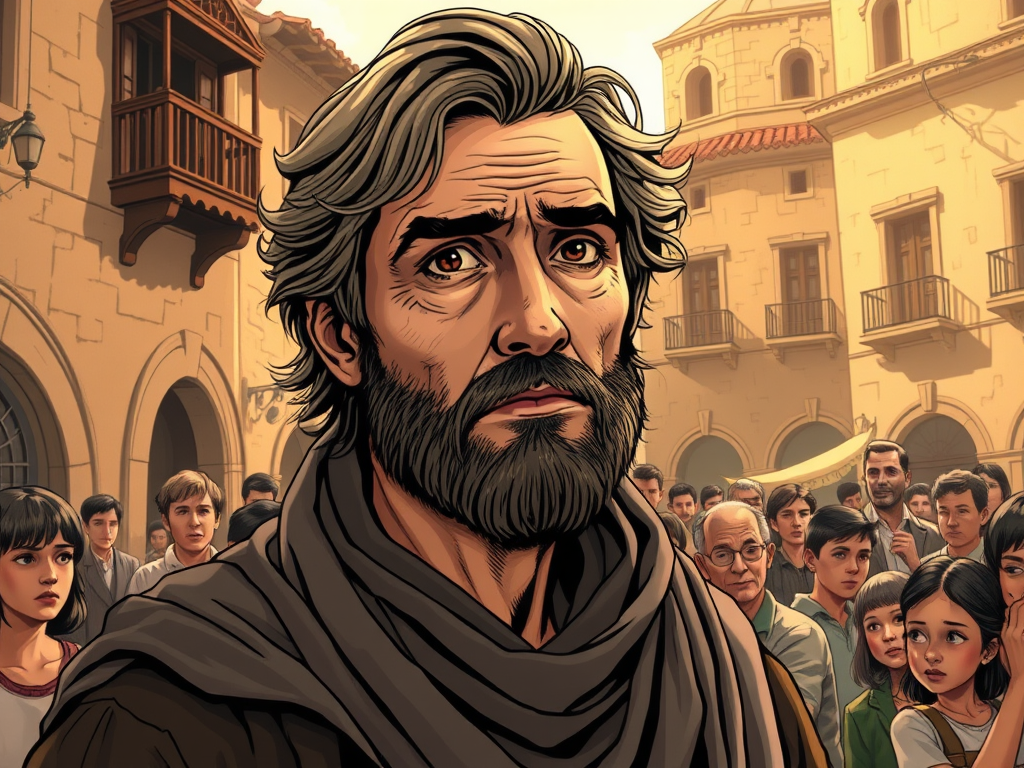
Elias began organizing meetings in the old town square. There, he shared what he had learned and encouraged young people to reflect on their choices.
He didn't tell them what to do, he just challenged them to think: “Are you living the life you chose or the life that was imposed on you?”.
Moral of the Story: Elias' Choice
Based on the teachings of Jean-Paul Sartre, This story teaches us that freedom is a gift that comes with the responsibility of creating our own meaning.
We are the authors of our own existence, and even amid uncertainty, we have the power to transform our lives through our choices.
Se você deseja explorar mais histórias que inspiram e desafiam, visite nosso blog: Messages that Inspire.
Frequently Asked Questions
1. Who was Jean-Paul Sartre?
Jean-Paul Sartre was a philosopher, French writer and playwright, considered one of the leading representatives of existentialism.
2. What does “Existence precedes essence” mean?
It means that human beings first exist and, through their choices and actions, define who they are.
3. How can Sartre's philosophy help in everyday life?
She teaches us to take responsibility for our choices and to create our own meaning in life.
4. Why did Elijah decide to change his life?
He realized that he was living according to other people's expectations and decided to take control of his own life.
5. What does freedom mean in Sartre's philosophy?
Freedom means the ability to make conscious choices and live with the consequences of those choices.
6. How to deal with choice anxiety?
Recognizing that uncertainty is part of freedom and using it as an opportunity to grow and get to know yourself better.
7. Is Sartre's philosophy optimistic or pessimistic?
She is realistic and empowering, as she places the responsibility of creating meaning in our own hands.







 Português do Brasil
  English
  Español
  Français