

Have you ever thought about how the dramas of thousands of years ago still make sense today? Yes, the Greek tragedy has that power.
And when we talk about Euripides, we're talking about the rebel of the bunch. He wasn't afraid to question the gods or show the rawest human side.
Get ready for a trip back in time. Let's explore the mind of this genius with quotes that will turn your head.
Who was Euripides in the History of Theater?
Before we dive into the phrases, we need to understand the guy. Euripides was one of the three great tragediographers of classical Athens.
Unlike his colleagues, he focused a lot on psychological realism. He gave a voice to women and slaves in his plays, something unthinkable at the time.
His work has survived the ages precisely because of this human connection. He understood pain, passion and madness like no one else.
To find out more about his life, check out the full biography on Wikipedia.
Now, let's get down to business: the words that have spanned millennia.
Euripides' Best Quotes on Human Nature
We begin our list with reflections on who we are. Euripides knew that human beings are a box of surprises, not always pleasant ones.
“There is no worse evil than a bad friend.” - Euripides
Betrayal and loyalty were recurring themes. This phrase reminds us to value who is really by our side.
“Time will tell. It's a talker, and it doesn't need to be questioned.” - Euripides
Here, he teaches us about patience. The truth always comes out, there's no point in pushing it.
“No man is capable of being happy in everything.” - Euripides
A dose of reality. Perfection doesn't exist, and accepting that is the first step towards peace of mind.
“He who neglects learning in youth loses the past and is dead to the future.” - Euripides
Education was vital in Ancient Greece. Euripides reinforces that knowledge is the key to existence.
“Question everything. Learn something. Answer nothing.” - Euripides
This skeptical attitude is the basis of philosophy. Curiosity drives the world, not absolute certainties.
“Cowards never start and the weak never finish.” - Euripides
A powerful quote about persistence and courage. Success requires continuous action.
“There is one thing that darkness cannot hide: the truth.” - Euripides
Even in the shadows of tragedy, the reality of the facts always emerges. It's a lesson in integrity.
“A sure friend reveals himself in uncertainty.” - Euripides
One more about friendship. It's in difficult times, or in tragedies, that we see who's who.
“Speaking the truth is simple.” - Euripides
We don't need to beat around the bush when we're honest. Complexity often hides lies.
“Wise is he who knows what is useful, not many things.” - Euripides
Practical knowledge is worth more than memorized encyclopedias. A timeless lesson from Euripides.
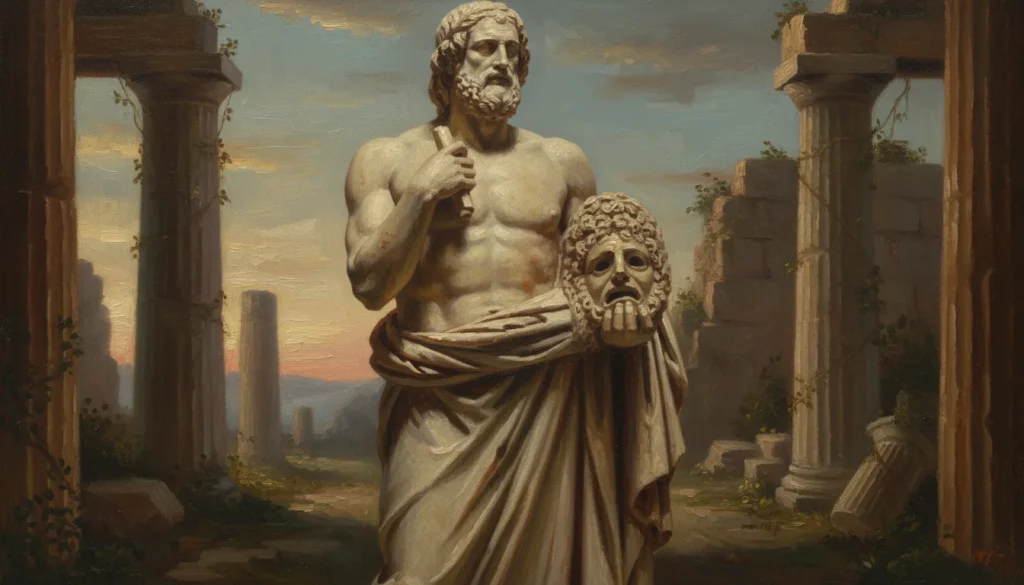



Euripides and his Reflections on Love and Passion
Ah, love! Or is it the tragedy of love? In the plays of Euripides, as in Medea, The feeling is intense and often dangerous.
“Love is all we have, the only way we can help each other.” - Euripides
Even with all the drama, he recognized the uniting power of affection.
“There is nothing like a mother's love for her children.” - Euripides
This phrase resonates strongly, especially considering the twists and turns of his maternal plays.
“Love makes poets of men, even if they weren't good at music before.” - Euripides
Inspiration is born of passion. Let anyone who has never written a verse in love cast the first stone.
“Where there is no wine, there is no love, nor any other pleasure for mortals.” - Euripides
A clear reference to Dionysus, the god of theater and wine. The celebration of life demands its elixirs.
“Love is the most terrible, and also the most generous of passions.” - Euripides
The duality that kills and heals. Euripides captured this paradox perfectly.
“Those who love are delirious.” - Euripides
Short and to the point. Passion takes away reason, and that is the driving force behind many of their tragedies.
“Moderate loves last longer.” - Euripides
A word of advice on balance. A fire that burns too brightly burns too quickly.
“Woman, when wounded in love, becomes an indomitable beast.” - Euripides
This brings us directly to Medea's fury. The danger of a broken heart is real.
“Love is not just a feeling, it's an art.” - Euripides
It requires skill, care and dedication. It's not something that just happens by chance.
“Affection is the hardest thing to tear from the heart.” - Euripides
Forgetting is the most painful part of the end. A universal truth spoken for centuries.
If you'd like to understand more about the structure of these stories, the Brasil Escola has a great article on Greek tragedy.
Euripides' Wisdom on Suffering and Fate
Life in Greece wasn't easy, and the theater served as a catharsis. Euripides didn't give the pill about the pain.
“Don't waste fresh tears on old sorrows.” - Euripides
Practical advice on overcoming. To mourn the past is to miss the present.
“Destiny finds paths we never imagined.” - Euripides
The gods weave life in mysterious ways. Accepting the unexpected is wisdom.
“Wealth does not bring wisdom, but gives opportunities for folly.” - Euripides
Money can't buy common sense. It often only finances bigger mistakes.
“Ten wise soldiers are worth more than a thousand ignorant ones.” - Euripides
Quality trumps quantity, whether in war or in life. Strategy is everything.
“He who submits to fate is wise among men.” - Euripides
It's not about giving up, it's about understanding the flow of the universe. Fighting the inevitable is pointless.
“Pain is the midwife of wisdom.” - Euripides
We learn more by falling than by flying. Suffering, unfortunately, teaches.
“The gods give us many surprises: the expected is not fulfilled, and a god opens the way to the unexpected.” - Euripides
This is the essence of Deus ex Machina. The surprising ending that solves everything.
“No one is free; they are either slaves to money or to luck.” - Euripides
A sharp social critique. Total freedom is a human illusion.
“Silence is the best answer to anger.” - Euripides
In moments of rage, keeping quiet prevents tragedies. Emotional control is power.
“Hope is the food of exiles.” - Euripides
When everything is taken away from us, we can only hope for better days.

“The most tragic of poets”, in the words of Aristotle, Along with Aeschylus and Sophocles, Euripides is one of the three great Athenian playwrights of the 5th century B.C. Portrayed ironically in many of Aristophanes' comedies and having won theatrical competitions only five times, the author of The Trojans and other fundamental tragedies bequeathed a work of immense scope, the resonance of which is still present in contemporary theater, cinema and literature. Of the ninety-two plays attributed to him by tradition, only nineteen have been preserved, but this is enough to show the markedly existential nature of his work, the intensity of his individual feelings, the power of his lyrical words and the freedom with which he works with myth, marking the structure of classical drama with his own characteristics.
Euripides' Messages on Society and Justice
He was also a critic of his time. Euripides used the stage to poke fun at Athenian society.
“When a good man is hurt, all those who call themselves good must suffer with him.” - Euripides
Empathy is a collective duty. The pain of one must be the concern of all.
“Justice is the revenge of the social man.” - Euripides
An interesting insight into how we organize punishment. The law replaces barbarism.
“Judge not lest you be judged, for the measure you use will be used with you.” - Euripides
Curiously similar to later biblical texts. Reciprocity is a universal law.
“The superior man is the one who is faithful to his own nature.” - Euripides
Authenticity was valued. Don't try to be someone you're not in order to please the polis.
“Tyranny is the mother of injustice.” - Euripides
Absolute power corrupts. Euripides defended democracy, even with its flaws.
“A just man is better than a written law.” - Euripides
Character is worth more than bureaucracy. Laws can be flawed virtue no.
“War is the evil that consumes the best sons.” - Euripides
He saw the horrors of the Peloponnesian War. His anti-war plays are touching.
“Old age is nothing more than the repetition of mistakes.” - Euripides
A cynical but reflective view. Do we learn or just repeat patterns?
“Courage in war is virtue; in peace, it is danger.” - Euripides
Knowing how to direct aggression is vital. The warrior needs to know when to sheathe his sword.
“Happy is he who has escaped the storm and found the harbor.” - Euripides
To close the quotes, a message of relief. We are all looking for our safe haven.
Comparison of the Great Tragediographers
For you to understand where Euripides fits, take a look at this quick table:
| Feature | Aeschylus | Sophocles | Euripides |
|---|---|---|---|
| Focus | Gods and Divine Justice | The Hero and his Destiny | Human Psychology and Passion |
| Style | Grand and solemn | Balanced and Ideal | Realistic and questioning |
| Innovation | Introduced the 2nd actor | Introduced the 3rd actor | He used the Deus ex Machina |
| Vision | Traditional | Idealized | Critic and Rebel |
Quick Glossary of Tragedy Terms
Don't get bogged down in technical terms. Here's a quick guide:
1. Catharsis: It's the purification of emotions. That relief you feel after crying watching a play or movie.
2. Hubris: The excessive pride that leads the hero to ruin. It's when the character thinks he can do more than the gods.
3. Deus ex Machina: A feature where a god descends (in a machine) at the end of the play to solve all the impossible problems.
How to Read a Tragedy by Euripides
Want to start reading the original parts? Follow these numerical steps so you don't get lost:
- Choose a modern, annotated translation to make it easier to understand the context.
- Read the myth before the play. The Greeks already knew the story, the focus was on how it would be told.
- Pay attention to the Chorus. They explain what is happening and give the moral of the story.
- Identify the central conflict. It is usually between human passion and divine law.
- Don't judge with today's eyes. Remember that it was written 2,500 years ago.
Main conclusions about Euripides
Euripides was undoubtedly the most modern of the ancients. He looked inside the human being and saw abysses that we prefer to ignore.
His phrases about love, hate and destiny are still relevant because human nature has changed so little. We are still passionate, flawed and in search of answers.
Reading his quotes, you realize that he didn't just want to entertain. He wanted to disturb, make us think and, above all, make us feel alive.
So take these lessons with you. The wisdom of Ancient Greece is a beacon that never goes out.
FAQ: Frequently Asked Questions
1. What is Euripides' most famous play?
The most acclaimed play is Medea. It recounts the terrible revenge of a woman betrayed by her husband, Jason. It's a profound study of jealousy and rage.
2. Why was Euripides considered controversial?
He questioned the traditional gods and gave prominent roles and intelligence to women and slaves, which shocked the conservative society of Athens.
3. What does the phrase “He who loves is delirious” mean?
It means that intense passion takes away a person's rationality. Euripides believed that love could be a destructive and uncontrollable force.
4. How many plays did Euripides write?
It is estimated that he wrote around 92 plays, but only 18 tragedies (and one satirical drama) have survived complete to this day.
5. What can we learn from Euripides today?
We can learn about the complexity of human emotions. It teaches us that we are flawed and that fate is unpredictable, encouraging empathy and critical reflection.